
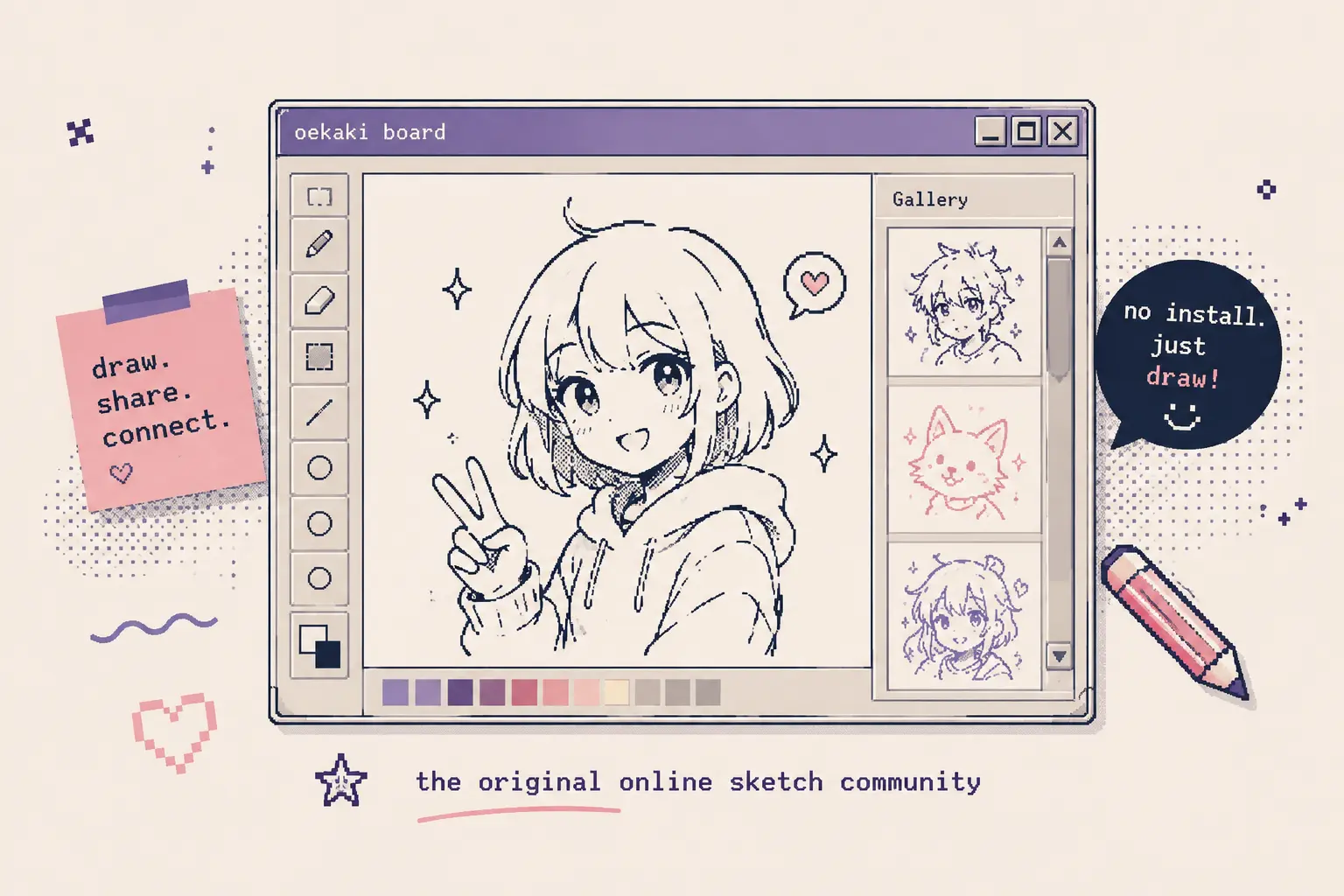
An oekaki board is a forum that allows visitors to draw directly inside their browser and post the sketch straight to the gallery even without downloading any software. The word oekaki comes from a Japanese term oekaki, which means simply drawing or doodling. These were casual sketch spaces, not polished portfolio sites. Before the era of Discord art channels or DeviantArt journals, this stand personal homepage era of internet culture, and interestingly, nobody talks about it anymore.
Table of Contents
What Oekaki Art Actually Means
Oekaki art has a specific type of look: It features thick outlines, limited color palettes, and a slightly rough, sketchbook quality that comes directly from the tools it was made with. According to the detailed history on the Manga Wiki, the term actually refers to a described bulletin board system where artists drew inside an online drawing environment rather than uploading a finished file. This causes old Oekaki drawings to look unmistakably similar across completely unrelated boards.
How an Oekaki Website Worked
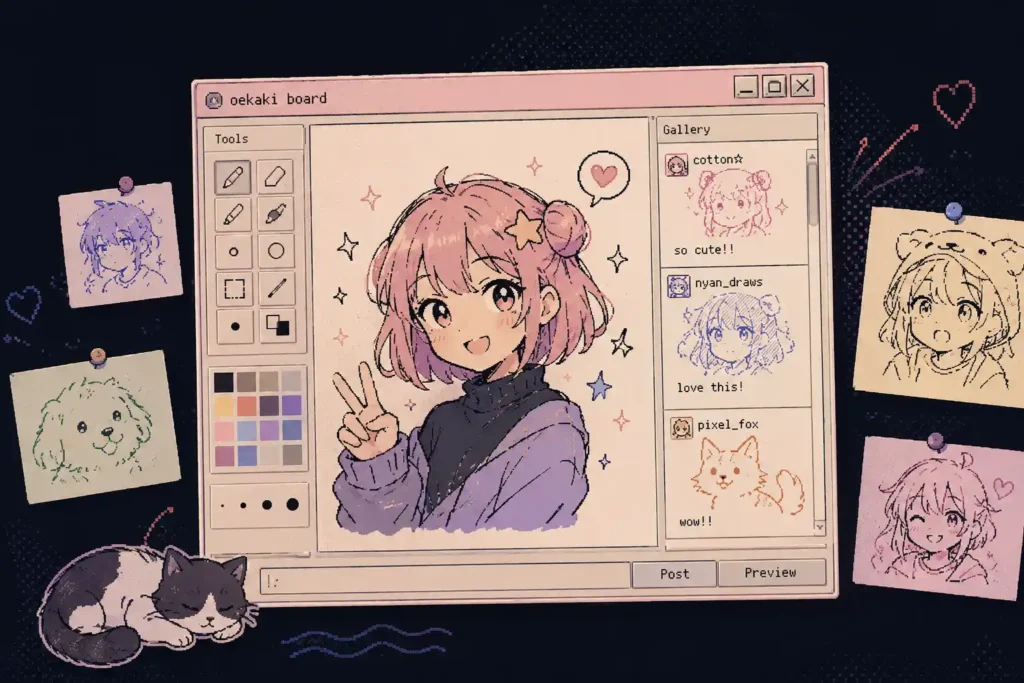
An oekaki website ran on a small applet embedded right into the forum page. When you click “New post,” a canvas and toolbar load, and then you need to draw with a mouse or a tablet without leaving the browser tab. After finishing the drawing, you can post it publicly alongside a comment field, exactly like replying to a thread, which made every oekaki drawing board feel more like a conversation than a gallery submission. Same like this, we also covered the first widgets covered in website shoutboxes, where the interaction itself was the whole point of the page.
The Applets Behind the Canvas
The software changed over the format’s lifespan. OekakiBBS was one of the original tools, with small color palettes and basic features. Then a developer known as Shi-chan built PaintBBS, and it became the most widely used version. An English fork called Wacintaki Poteto grew out of an earlier program named OekakiPoteto, and it became widely used outside Japan. Coming to the modern side, oekaki drawing websites have mostly moved off Java entirely. A currently active board, freakphone.net’s Drawing Room, offers artists a choice between PaintBBS NEO, Shi-Painter, ChickenPaint, and Klecks, all these softwares run through entirely Javascript tools instead of the old applets.
One feature that I find particularly interesting is what made Oekaki genuinely distinct from normal art-sharing sites: from a normal art-sharing site: many boards recorded the entire drawing process, stroke by stroke, and even let visitors replay it afterwards like a short animation. For an oekaki art community built around learning from each other, the drawing process could be just as important as the final image.
The Rise of Anime and Furry Oekaki Communities
When it comes to Old anime oekaki boards spread fast in the 2000s because the format let fans without any drawing software installed still contribute art to a shared board, whether that board covered a general anime aesthetic or one specific show. Oekaki boards in the 2000s activity clustered around titles like Naruto, Avatar: The Last Airbender, and Teen Titans. We can see firsthand accounts on the MelonLand forum’s oekaki thread, where former users describe boards with entire sketch and skill-tiered sections built around specific fandoms.
Separately, anime oekaki boards had a strong furry counterpart. That furry lineage is still visible today: Ziggy’s Toon Gallery runs a gallery that was built entirely on ChickenPaint as its drawing tool, proof that the format never fully died in the communities where it started. This same fandom-first instinct also appeared in fan shrine websites, which grew from the same fandom-first instinct.
Why Oekaki Boards Faded
The history of oekaki boards closely deals with the death of browser plugins. In the early 2010s, Java applets became a security liability as browsers phased out plugin support. At the same time, DeviantArt introduced the plugin-free platforms that allowed artists to share their work easily. Static hosts that later powered a lot of the indie web, including Neocities, could not run the server-side scripts old oekaki boards needed either, which made starting a new one harder, just when the format needed to be reinvented. This is the same as documented in Forgotten Websites and worlds and websites that nobody visits anymore, where outdated technology quietly caused entire communities to disappear.
Old oekaki websites never fully disappeared. In recent years, they have simply become smaller and quieter. A blogger at kiriska.com documented reviving a board using an HTML5 port of the classic PaintBBS interface, built on a template called POTI-board. Freakphone.net’s Drawing Room and Ziggy’s Toon Gallery are Both are live examples today.
These revival boards are intentionally small, closer to a private clubhouse than the sprawling old online art communities of the mid-2000s; interestingly, the shared browser canvas is unchanged. It’s the same small-web instinct driving the indie web revival across other forgotten formats.
Frequently Asked Questions
Are there still active oekaki boards?
Yes. You can check that Freakphone’s Drawing Room and Ziggy’s Toon Gallery are both currently running boards. For real-time drawing with others, they use iScribble.
Do you need special software for an oekaki drawing board?
No. The tool loads inside the browser. Older versions rely on Java completely, which caused compatibility issues once browsers dropped plugin support. But current versions are built on modern JavaScript tools like ChickenPaint and Klecks instead.

Asif BC is a web developer with 2 years of professional experience in website development and modern web technologies. As the creator of Curiouxify, he researches and writes about interactive websites, internet history, browser experiments, digital culture, and the evolution of the web. His articles combine technical knowledge with careful research to document the creative and lesser-known corners of the internet.