
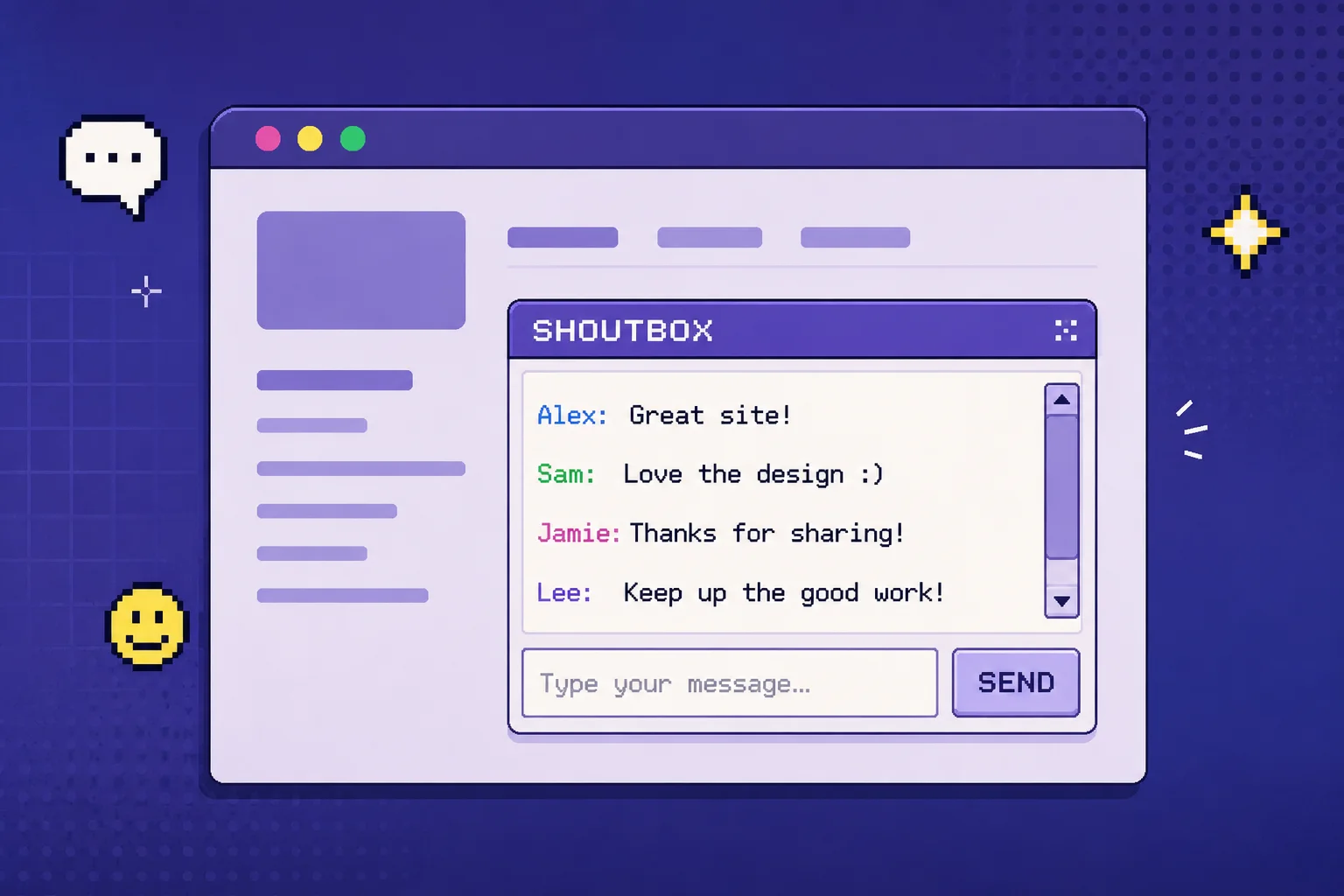
A website shoutbox is a small embedded chat box that lets visitors post short, real-time messages on a website’s home page or inner pages. It became one of the most common ways for visitors to communicate with website owners in the mid 2000s. Services like Cbox and ShoutMix provided millions of boxes, letting visitors and creators chat without the help of forums or writing any backend code.
Table of Contents
What a Website Shoutbox Actually Was
A website shoutbox was usually a narrow box that stuck on the website’s sidebar, even sometimes just a few hundred pixels wide. This kind of website sidebar chat let visitors type a message, add their name and hit the send button. The messages were sorted by time, so the box read like a running strip of comments.
Most of the site owners embedded a shoutbox widget using a small script provided by a third-party service. The most popular names people will remember are Cbox and ShoutMix. Both almost worked the same way. You signed up on the site, and they provided you with a code that can paste into your website, and the website chat widget appeared wherever you placed the code. The same concept was also used in 88×31 web button sites during the same era.
Most hobbyists were excited to build a live chatbox. Some programming languages provide a free chatbox using code. It looks like a fan shrine website. No big thing, just copy and paste, and messages appeared the moment someone hit send.
How a Website Shoutbox Worked Behind the Scenes
This is the part of website shoutbox history that almost all articles skip, and it explains why the format behaved the way it did.
The shoutbox widget itself did not live on your website. From a technical perspective, it is saving your name and message on the provider’s own servers, not the creator’s database. When you pasted the script of the code into your page, you were embedding a live window into someone else’s system, usually through an iframe or short script tag. Every message a visitor typed into a website tagboard goes directly to the service provider’s database, and it is displayed back through the window. That’s how this system works.
This explains why the website chat widget often updates without even the page reloading because the chat is handled on the server side. There was also another issue: many shoutbox widgets vanished overnight without any warning. When a service provider shut down or stopped renewing its own hosting, every website using that embed code will lost; this means none of the conversation history ever actually belonged to the site owner.
Shoutbox vs Guestbook: What Was the Real Difference
People often search for what is the difference between a shoutbox and a guestbook because they may be confused many times, but they solve different problems and are rarely replaced by each other.
| Guestbook | Shoutbox |
| Long messages | Short messages |
| Separate page | Sidebar or homepage |
| Visitor record | Live conversation |
| Slower interaction | Real time chat |
Using a guestbook was slower and more formal. Visitors left a single message, sometimes long, often written like a note in a physical guestbook at a wedding. The message is stored in order, usually on another page, and it’s very rarely turned into an actual back-and-forth conversation.
A website tagboard worked more like a live chat feed. Messages appeared very fast. Visitors even replied to each other. The same handmade feel you’ll find on blinkie websites from the same period.
Some website owners often ran both a guestbook and a shoutbox widget at the same time, and this is what most people miss in articles based on shoutbox and guestbook. The guestbook was a lasting record of who visited the site; it’s almost like a signature in a physical book. The website tagboard was where the actual, ongoing community lived, one short message at a time. In short, one was proof you were there, and another one is staying there.
Why Website Shoutboxes Spread So Fast
When I researched this, I noticed that there are 3 things that helped this feature spread across the world.
First, they were free services. Services like Cbox and ShoutMix offered a basic Shoutbox widget at no cost, which triggered developers and hobbyists to create these types of websites.
The second reason is that they were easy to install. Just copy the code and paste it on your layout, and you’ we’re done. There was no need for plugins, no server setup, and no technical knowledge required for this.
And last, a website chat widget filled a real gap. Before the comments section became popular on blogs, this was often the only way a visitor could talk back to a site owner in real time. For fan sites especially, it created a genuine way to discuss the topic, whether that was a band, a TV show, or anything that people cared about. The same connective role played by internet webrings.
The Spam Problem
The same freedom that made the shoutbox widget easy to adopt also made it an easy target. Most tagboards didn’t require any login or verification, which created a loophole for spam bots and junk messages.
Site owners tried a handful of fixes. Some added word restrictions. Some required answering a simple CAPTCHA-style math question. Others switched shoutbox widget providers entirely.
This constant upkeep is one of the real reasons the format eventually fell out of favor, a detail most website shoutbox history articles skip. Running a shoutbox requires checking, deleting junk messages and even banning the spammers.
What Replaced Website Shoutboxes
With the arrival of blog comment sections directly on posts, the use of website sidebar chat boxes ended. Facebook later released an embeddable comments plugin that many site owners adopted because it reduced spam through built-in identity verification.
Instead of visiting someone’s website to leave a message on a website tagboard, people can directly comment on posts or send direct messages to the creators.
There is still a small percentage of shoutbox service is still running today. During research into website shoutbox history, one long-standing ShoutMix-style brand actually turned into business messaging software, and this shows how much the original personal website widgets use case has changed. Most of them still appear in indie web revival-style websites.
Frequently Asked Questions
Is Cbox still around?
Yes. Cbox is still operating, although far fewer websites use it today compared to its peak during the 2000s.
Can I still add a shoutbox widget to my website today?
Yes. A few services, including Cbox, still offer embeddable website chat widget options for modern websites. But most owners prefer the comment section or social media integration.
What is the difference between a shoutbox and a website tagboard?
The term is largely used interchangeably. Some services called their product a website tagboard instead of a shoutbox, but the system works the same. It was simply a small, real-time chat widget embedded on a website.
Why did shoutboxes disappear from so many websites?
Modern platforms need fast and secure services. The shoutbox widget was hosted on the provider’s own servers rather than the site developer’s. If a provider shut down, every website using that service could lose its chatbox overnight.

Asif BC is a web developer with 2 years of professional experience in website development and modern web technologies. As the creator of Curiouxify, he researches and writes about interactive websites, internet history, browser experiments, digital culture, and the evolution of the web. His articles combine technical knowledge with careful research to document the creative and lesser-known corners of the internet.