
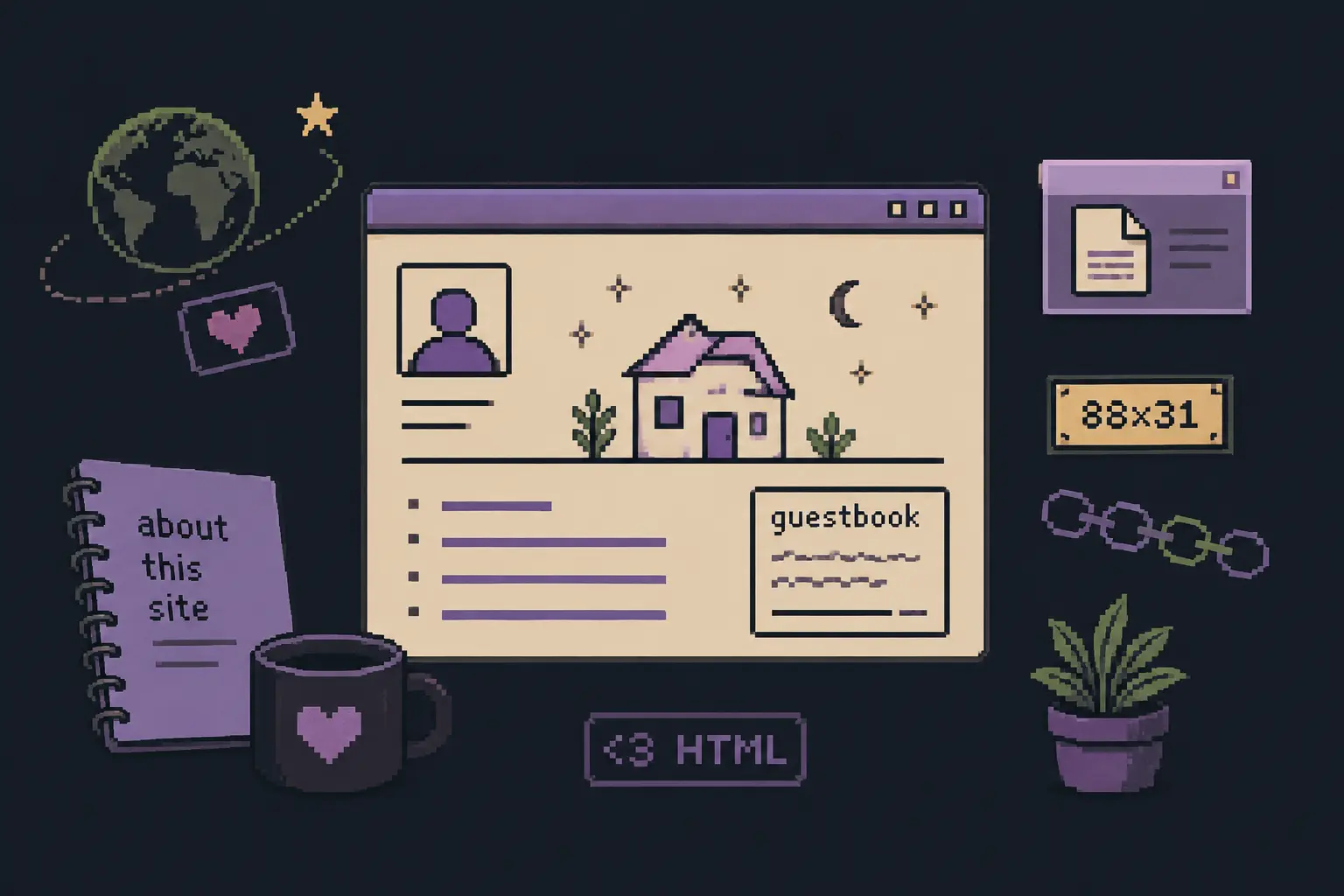
The Handmade Web: Why People Still Build Websites by Hand
The Handmade Web describes websites built by one person by hand, without using a template or modern AI systems. It names both a design philosophy and a real moment in the earliest internet history: the mid-to-late 1990s, when the early internet was small enough that a single personal website felt like its own little corner of the internet. Today it also describes people rejecting automated tools in favour of handmade HTML code.
Table of Contents
What the Term Actually Means
A handmade site is written and maintained directly by its creator, not assembled from a drag-and-drop kit. Even creators treats as a craft, not a checkbox, and usually skip polished homepage design trends for something rougher and often reflecting the personality of the person who made it. This was against most of today’s web culture, where a handful of platforms generate nearly every page people visit.
Where It Came From
In 2015, J.R. Carpenter introduced “A Handmade Web”, which defines pages coded by hand and maintained by individuals rather than businesses. People didn’t realize the future belongs to AI-generated code or drag and drop based website. Even in my teenage years, I was excited to write code, but most of it failed, and there was less education we could find on Google at that time. Nowadays, people can easily build a website using modern tools and deploy websites easily with the help of Artificial Intelligence.
When I was researching this, the idea builds on Olia Lianlina’s 2005 “A Vernacular Web”, which describes the mid-1990s as bright, personal, and permanently under construction before usability experts took over. This comes under real internet culture history from generic retro web aesthetics.
| Year | Event |
| 1991 | The World Wide Web becomes publicly available, making personal publishing possible. |
| 1994 | GeoCities launches, giving millions of people a place to build hand-coded personal websites. |
| 1995–1999 | Personal homepages, web directories, guestbooks, webrings, and 88×31 buttons become defining features of the early web. |
| 2005 | Olia Lialina publishes A Vernacular Web, highlighting the cultural value of the early, hand-built web. |
| 2012 | Anil Dash publishes The Web We Lost, renewing interest in owning personal websites instead of relying on social platforms. |
| 2013 | Neocities launches to preserve and revive the spirit of GeoCities and personal websites. |
| 2015 | J. R. Carpenter presents A Handmade Web, giving the movement its most widely recognized modern definition. |
| Today | The Handmade Web continues through the IndieWeb, Small Web, digital gardens, personal websites, and other independently built web projects. |
When GeoCities launched in 1994, people could easily claim free server space, organized into neighborhoods, and it became the largest cluster of homepages the web had seen, an interesting thing almost all coded by their owners. With web directories doing the heavy lifting for web navigation, curation happened through webrings, which helped to find dozens of related personal websites together, plus guestbooks and 88×31 buttons and internet guestbooks turned the audience into a larger, wider community. This is the exact time when the link exchange culture became more popular, long before any blog network or blogosphere existed.
Handmade Web vs. Indie Web vs. Small Web vs. Old Web
| Term | What it actually means |
| Handmade web | Sites coded by hand by an individual, in any era |
| Indie web | A modern movement with its own protocols for owning your content |
| Small web | A push toward simple, lightweight sites, regardless of who codes them |
| Old web | A time period, not a philosophy; old pages can be handmade or mass-produced |
A site can be made without joining the formal indie web movement, and a small web project can still run on modern frameworks. What unites them is the idea that in the age of automated and template-based frameworks, people still write code by hand published to the open web.
Two Different Communities, Same Name
One comes from the work of Carpenter and Lialina: art, authorship, and hypermedia, living on through Neocities and creative websites treated as ongoing work rather than finished products.
The other is the Handmade Network’s programming philosophy, which questions whether modern frameworks are even necessary and experiments with lean, hand-rolled alternatives to large JavaScript (JS) frameworks.
In simple terms, one is closer to art, and the other is closer to engineering. Most articles I read miss this point.
Why It’s Back
Neocities, founded in 2013 to keep the spirit of GeoCities, now hosts more than a million sites, with sharp growth in the last few years. Writer Anil Dash wrote an essay, “The Web We Lost”, in 2012; people once expected to own their personal website instead of renting identity from a platform. As AI-generated pages and templated microsites flood search results, handmade web pages have gained the trust of the owner. This is why the least “optimized” one-page websites and static websites are suddenly some of the most trusted websites on the internet.
What a Handmade Page Usually Has
- A links page reviving old link exchange habits
- Guestbooks instead of platform comments
- A dated digital diary entry instead of an algorithmic feed
- RSS feeds followed through dedicated RSS readers and feed readers, for people who prefer web surfing over scrolling
- A start-page the owner curates by hand instead of an automated internet directory
How to Start One
You need a text editor and basic knowledge of HTML, which you can learn from W3Schools and deploy it to Neocities or a simple static file host. Start with a one-page website, a style list of links you actually visit, and a guestbook for users. Skip main frameworks until you’ve written plain HTML yourself.
The personal homepage era worked because nobody waited for permission before publishing. Join active webrings or a small website directory run by other hand-coders, since search engines mainly look for commercial ones over a lone personal homepage.
FAQ
Is the handmade web the same as the indie web?
No. A handmade website is about hand-coding and authorship in any era. Indie web is a specific modern movement with its own technical standards.
Do old, abandoned pages automatically count?
Only if the creator actually coded them by hand. Many dead websites and archived websites from the 1990s used early WYSIWYG tools instead. Many sites can be found on Internet Archive’s Wayback Machine.
The Takeaway
The handmade web doesn’t mean vintage web nostalgia for its own sake. It’s proof that a website can still be personal, built by hand. Build it yourself, keep it small, and let it look like you made it, because you did. Even some of the websites we saw today were probably written by hand in the early stage of development.
If you found this article helpful, I suggest reading Blinkie and Fanlisting will make you an internet enthusiast.

Asif BC is a web developer with 2 years of professional experience in website development and modern web technologies. As the creator of Curiouxify, he researches and writes about interactive websites, internet history, browser experiments, digital culture, and the evolution of the web. His articles combine technical knowledge with careful research to document the creative and lesser-known corners of the internet.