
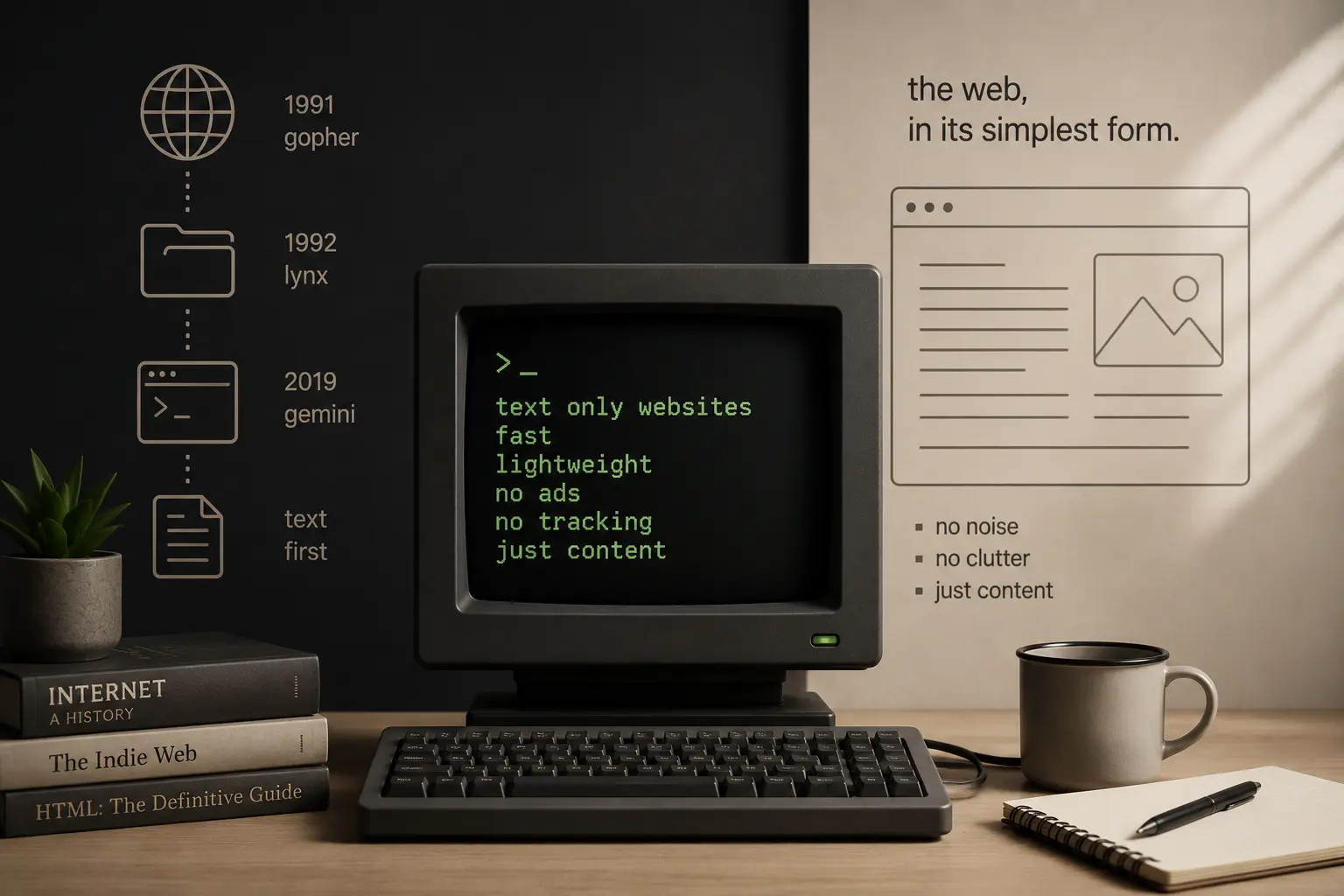
Text only websites are pages built with almost no images, styling, or scripts, so they render as plain text, are easy to read, and load instantly. They are not a modern trend. Some of the earliest working sites look like this, and a small but active corner of the internet still uses these traditional sites.
Table of Contents
A Short History of the Text-Only Websites
Long before the arrival of Chrome or Firefox existed, the internet already had a plain-text era. In 1991, Gopher introduced a system built entirely around text-based navigation, with no graphics involved. It briefly rivalled the early web before HTML pages took over.
Then came Lynx, released in 1992. It is a terminal-based browser that renders pages with pure text, and the interesting thing is this under active development more than three decades later. Lynx predates Netscape, which means the only-text web is not a reaction to a bloated modern internet. This marks the beginning of the text-first web.
| 1991 | Gopher is released. | Introduced a simple, menu-driven way to organize information using plain text. |
| 1992 | Lynx browser launches. | One of the first widely used text-only web browsers, proving the web could be useful without graphics. |
| 1993 | Mosaic popularizes graphical browsing. | Images and visual layouts became mainstream, shifting the web away from text-first experiences. |
| Mid-1990s | HTML websites become increasingly visual. | Backgrounds, images, tables, and later CSS transformed how websites were designed. |
| 2000s | Mobile-friendly and lightweight web versions appear. | Many websites created simplified pages to improve loading speeds on slower mobile connections. |
| 2010s | Reader Mode becomes common in browsers. | Browsers began offering distraction-free reading by stripping away ads and unnecessary page elements. |
| 2019 | Gemini Protocol is introduced. | Brought a modern, text-first publishing platform inspired by Gopher and the early web. |
| Today | The Indie Web continues the tradition. | Text-only websites remain popular among developers, writers, privacy advocates, and digital minimalists who value simplicity over visual complexity. |
Why Text-Only Websites Still Matter
Modern web pages are often heavy with tracking scripts, videos in the background, and pop-ups before a single word loads. A text-based website skips all of that by design, not by accident.
Here are some advantages of text-only websites.
- Speed : A web page without any videos or animation loads in a fraction of a second, even on a poor connection.
- Accessibility: Screen readers and assistive technology work more predictably on well-structured markup, which is a part of W3C’s accessibility guidelines that favor plain structure over design complexity.
- Low bandwidth: In many parts of the world, internet access is still expensive or unreliable, so a text-first page can be easy to load.
- Focus: Without any images or animation competing with the user experience, reading is simply easier.
- Nostalgia: For some people who grew up with the early web, plain text feels more secure to read, in the same spirit as the personal homepage era or old internet guestbook.
The Three Kinds of “Text Only” Web Experiences
There are 3 distinct things happening under one, and each one teaches why plain text still has a place online.
1. Purpose-built text-only websites
Some sites are designed from the ground up to contain nothing but only normal text. NPR Text is one of the most important examples in the mainstream. It carries only heading with old style and texts.
It proves minimalist text website does not have to mean a smaller or lesser version of a site. NPR websites carry the same journalism. The only difference is its simple text, which says something honest about how modern websites prioritise design rather than text content.
2. Tools that convert any page into text
This category does not build text-only pages at all. Instead, they rely on tools such as Textise, it convert any ordinary, image-heavy page into plain and readable text.
In short, these tools are not creating new web pages, it convert only the important things to text, cutting away the navigation and ads in the article.
3. Browsers built for the text-only web
The third category is not changing anything; it changes how it is viewed. For example, Lynx renders every page as plain text by default, images and all, regardless of how the site was actually built. It is the most literal expression of the text interface website idea, since the browser itself displays only text. It was released in 1992 and is still remains a genuinely usable way to browse modern web technology.
The Modern Underground: Gopher and Gemini Protocol
The instinct behind Gopher never fully disappeared. There is one actively mainted to built in lightweight and it’s called the Gemini protocol. It was popular among people want something closer to Gopher’s original simplicity than modern heavy-script websites. It matches the indie web revival mindset that favors personal ownership over than algorithm based content.
Gemini matters here because it shows the idea is not frozen in history. People are still actively finding this type of website that Lynx and Gopher established a decade ago. The thing is simple: text first, everything else optional. I once saw that the blogs of Satya Nadella and Sam altman’s blog are just text rather than any images or ads.
How to Make Your Own Site Text-Only
Turning a personal site into a minimalist text website does not require too much coding. Writing pages in plain HTML with minimal CSS, completely avoiding JS, and skipping images unless they add real meaning covers most of it. Many creators who build these sites treat the limitation as a creative choice rather than a technical shortcut, similar to how digital garden creators favor plain and personal writing rather than stuffed images.
The Takeaway
Text-only websites still stay relevant because some of them are still priorities. Wheather its NPR Text, a conversion tool like Textise, a dedicated browser like Lynx, or a newer protocol like Gemini, each one is solving the same problem with different aspects.
If this kind of website interests you, then you should read my webrings to the personal homepage era that shaped the history of the web.

Asif BC is a web developer with 2 years of professional experience in website development and modern web technologies. As the creator of Curiouxify, he researches and writes about interactive websites, internet history, browser experiments, digital culture, and the evolution of the web. His articles combine technical knowledge with careful research to document the creative and lesser-known corners of the internet.