
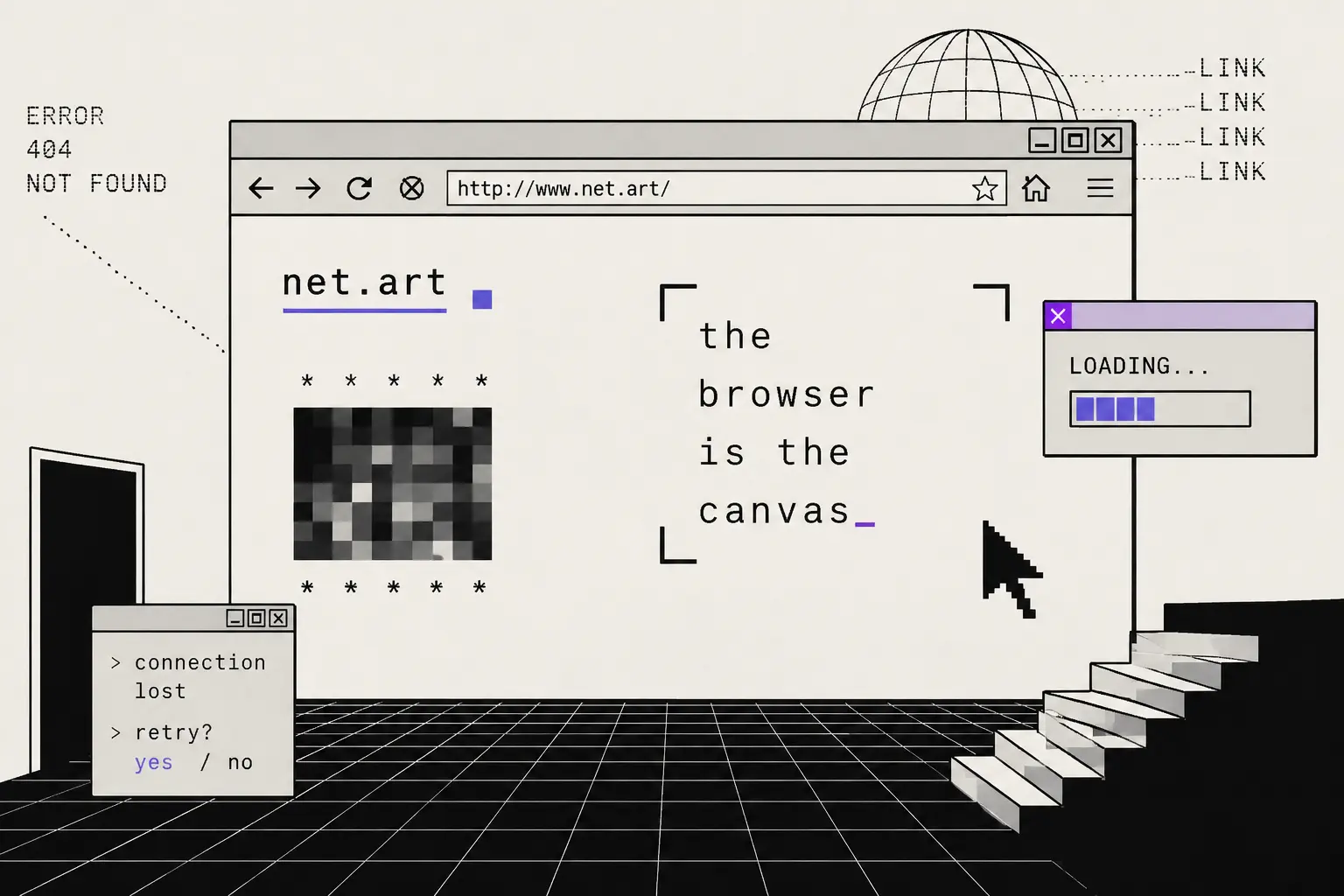
Net art is a specific branch of internet art made to exist inside the browser, using the hyperlink and the raw structure of a webpage as the medium rather than just showing a photo or a painting. Some writers use the word web art interchangeably, usually referring to the original 1990s movement specifically.
People search for it because most of the digital art online only covers Photoshop illustrations or NFTs; they completely skip the movement that treated the internet as a canvas long before either of those existed.
Table of Contents
Where Net Art History Actually Begins
The term net art has a strange origin story that most of the article misses. In December 1995, an artist from Slovakia, Vuk Cosic, received a garbled, anonymous email that had been mangled by incompatible email software.
The mail was buried in the unreadable text; one legible fragment, the only words he got, was “net.art”, and Cosic simply adopted it. Within a year, a loose network of artists, including Alexei Shulgin, Heath Bunting, and a duo working as JODI, had gathered around the term; the interesting part is that none of them coined it on purpose.
This origin matters for understanding internet art history as a whole, because the movement grew out of accident and improvisation rather than a manifesto; you can read the whole story from the “net.art” origin. These net artists were not trying to sell their art online. They were mailing list regulars making genuine art created for the internet and experimenting with what browsers could be forced to do.
Websites as a Form of Art, Not Just a Place to Show It
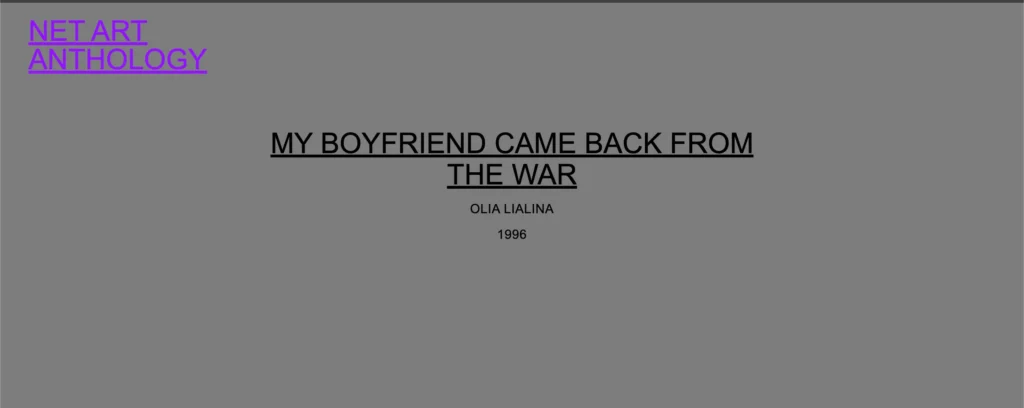
One thing I noticed was that what separated net art from ordinary illustration is the website’s own mechanics became the artwork. Russian artist Olia Lialina’s 1996 piece, often cited as one of the first true net art pieces, used browser frames and grainy black-and-white GIFs to tell a fragmented story. The story only unfolded as the users clicked through hyperlinks.
This is the clearest example of artists using websites as art rather than treating a website as a gallery. This art approach is still analysed today. The website’s HTML structure, its frames, and even its loading behavior were part of the piece.
The idea of websites as a form of art is the foundation for most later browser experiments and creative coding projects.
What Actually Separates Net Art From Ordinary Digital Art
Digital art history is much bigger than net art, covering almost everything from early browser computer graphics to modern generative work made in software that never touches a browser. Net art is the narrower slice that specifically depends on network conditions such as page loading, links, latency, and browser quirks to make its point.
| Term | Simple Meaning |
| Interactive Art | Art that responds to the viewer’s actions, such as clicks, touches, or movement. |
| Web Animation | Animation made with web technologies like GIFs, CSS, or JavaScript. |
| Net Art | Art that depends on the internet itself, including links, browsers, loading, or network behavior. |
Net art can use both, but it is defined by depending on the internet itself, not just by being animated or responsive.
The Aesthetics That Came Out of Net Art
Early net artists were working with dial-up connections and primitive browsers; internet aesthetics from this era leaned into low-bandwidth visuals rather than fighting against them. Pixelated GIFs, broken layouts used on purpose, and glitchy ASCII text all became recognizable web aesthetics rather than technical issues to hide.
This concept is what most people mean when they say browser art or browser-based art, even outside the strict net.art movement. After the end of dial-up internet, the pattern is still there. In early Flash experiments and, more recently, WebGL-based creative sites, we can see the rough and experimental look.
From Net Art to Today’s Experimental Art Online
In the early 2000s, experimental art made for the browser had spread well beyond the original net.art circle. Some archives like Rhizome’s Net Art Anthology began documenting and preserving these pieces. In that same period of time, browser software changes fast enough that a site built in 1998 can break entirely within a few years, and it takes the artwork with it.
The same preservation problem is still relevant to anyone building online art projects today. Many websites from the Flash era have already been disabled or are no longer working.
Modern web artists and internet artists use WebGL, canvas, and generative code instead of nested frames and GIFs, but the underlying instinct is identical. When looking at these, the browser is still treated as the material, not the delivery method. This spirit is behind much of the creative coding and digital art being made now, and those who build browser toys to experience rather than sell.
Frequently Asked Questions
Is net art the same thing as digital art?
No. Digital art is art created using digital tools. Interestingly, they don’t have an internet connection. Net art specifically depends on the internet itself. Examples include hyperlinks, Page loading, or network conditions to function as intended.
Why did net art often look broken or glitchy on purpose?
We all know that the early internet had slow connections and limited browsers, so net artists treated those restrictions as part of the aesthetic instead of trying to hide them.
The Takeaway
Net art proved that a website could be the artwork itself, not just a frame around one, decades before anyone was arguing about digital ownership online. The idea is not fully gone. It simply evolved from nested frames and dial-up GIFs into WebGL, generative code, and the small experimental corners of web culture that are still being built by people who treat the browser as their canvas.

Asif BC is a web developer with 2 years of professional experience in website development and modern web technologies. As the creator of Curiouxify, he researches and writes about interactive websites, internet history, browser experiments, digital culture, and the evolution of the web. His articles combine technical knowledge with careful research to document the creative and lesser-known corners of the internet.