
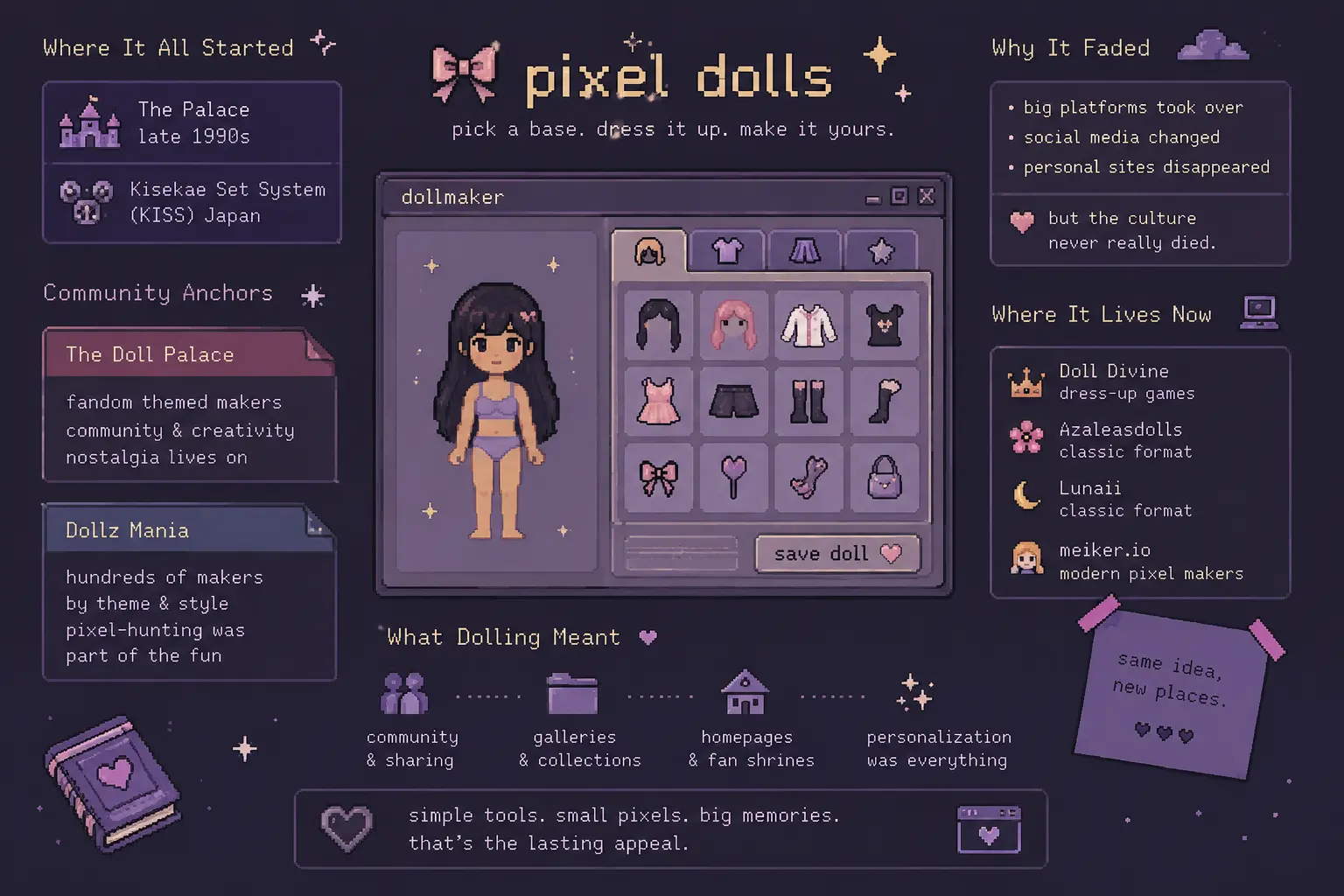
A dollmaker website where you can build a small character by dragging pieces of clothing, hair, and accessories onto a base body usually saves it as a single image in the end. In the late 1990s, this format became popular when early dollz appeared as pixel art rather than smooth vector graphics. People still make this because the appeal never really changed: pick a base, dress it up, and show it off somewhere.
Table of Contents
Where Pixel Dolls and Dollz Actually Started
The roots of pixel dolls can be traced to The Palace, where users can create small, customizable, paper-doll-style characters in the late 1990s. In 1997, these tiny characters later got a name: Pixel dollz.
Around the same period, Japan introduced its own charcter-customization tradition through the Kisekar Set System (KISS), which offered manga-styled base models with wardrobes and other interchangeable pieces.
Both worked around a similar idea. A base body stayed fixed while separate clothing and accessory pieces were layered on top until the character was complete. Based on Wikipedia’s entry on Dollz, the original pixel-art format stayed close to its roots even as newer dollmakers moved toward smoother ones and had more customizable designs.
The Doll Palace and Dollz Mania: Two Community Anchors
| The Doll Palace | Dollz Mania |
|---|---|
| Had a strong fan community built around themed dollmakers. | Felt more like a big collection of different dollmakers in one place. |
| You could find themes like Sailor Moon, Naruto, mermaids, and fairies. | Makers were sorted by characters, fandoms, styles, and fantasy themes. |
| It was more than just a place to make dolls; people also hung around and explored the site. | The main attraction was having so many different makers to try. |
| People could make a doll and then spend time checking out the other community features. | You could simply pick a theme you liked and start making a doll. |
| The original site is gone now, but old fan collections still keep its memory alive. | It became one of the names people remember when talking about old dollz maker sites. |
| Making a doll was fairly simple. | Pixel-hunting was part of the fun, especially when you had to line up every piece just right. |
Candybar Doll Maker and the Shift Toward Full Customization
Not every pixel character creator stayed locked to a fixed base body.
When I researched it, I notice that Candybar Doll Maker became an example of a different approach, allowing users to customize more than just the clothing layered over a fixed character. This makes people expect more from a character creator website, where the character underneath can be changed as much as the outfit.
This helped broaden the idea of what a dollmaker could be. Instead of choosing clothes for a predetermined figure, users could experiment with different combinations of features and create something that felt more personal.
Helped to shape the variety of 2000s pixel dolls. Traditional Dollz generally relied on fixed bodies and collections of clothing pieces, while Candybar-style tools moved toward more flexible customization.
What Dolling Actually Meant to the People Doing It
Dolling wasn’t simply another name for playing a browser game. Some people take it as a hobby with its own community and creative practices.
People traded finished dolls, credited the artists who created original bases, and built their own personal gallaries for the collections. Some of them displayed them on their personal home page or alongside a fan shrine dedicated to favorite characters, series, or fandom.
That habit fit naturally alongside other small-web customs from the same period. Finished websites can be seen in blinkies or on pages built during the same golden era of Flash websites.
The common thread was personalization. People weren’t simply visiting a website and consuming content. They were the whole websites, making something, saving it, displaying it, and adding these on their own corner of the web.
Old Dollmaker Websites and Makers You Can Still Explore
Most of the doll making websites have disappeared, which makes surviving archives and modern recreations particularly interesting.
Still, Doll Divine is one of the larger surviving destinations for browser-based dress-up experiences, with a wide collection of themed dress-up doll games. Azaleasdolls and Lunaii shows the classic dress-up format, closer in spirit to the original paper doll maker concept than to a modern social avatar platform.
For a pixel avatar maker with a modern method, sites such as meiker.io host a large collection of character and dress-up makers created by independent artists.
This not only gives you an experience in the 2000s Dollz community, but the underlying idea remains surprisingly familiar: choose a character, customize, save the avatar, and share it.
Why the Format Faded, and Where It Lives Now
First of all, virtual dolls never completely vanished, but their center of gravity shifted.
As large platforms covers casual browser gaming and social networks became the main place where people represented themselves online, standalone pixel art websites built around one specific hobby found it hard to survive.
The old Dollz ecosystem depended on personal websites, forums, fan communities, and people maintaining their own collections.
As those parts of the web became less central, many of these types of websites disappeared with them.
In archives and independent creators have kept parts of the culture alive, however. We can see them preserved on Neocities pages, while modern projects occasionally recreate the same style through community projects and browser-based games.
That is why old pixel doll maker websites still get rediscovered. For people like me, who spend hours hunting for the pixel-perfect outfit, the small surviving archive can feel like finding a forgotten room from the early web.
The Lasting Appeal
What made dolling stick wasn’t the technology behind it.
When talking of doll makers, they don’t need any advanced graphics or complicated software. It needed a base image, clothing layers, accessories, and space to save.
That simplicity is exactly why 2000s doll maker websites are still remembered fondly.
The characters were small. There was no advanced graphics system. The interfaces could be basic, yet users could take those simple pieces and turn them into something personal.
For many people, the finished doll wasn’t just an image. It was something they could put on their favorite pages, share with friends, add to a collection, or use to represent a fandom.
This is why the dollmaker websites are an interesting part of early web culture. They weren’t just primitive dress-up games. There was a small space where people experimented with identity, design, fandom, and personal expression.
And sometimes, the simplest websites are the ones that leave the clearest impression of what using the early web actually felt like.

Asif BC is a web developer with 2 years of professional experience in website development and modern web technologies. As the creator of Curiouxify, he researches and writes about interactive websites, internet history, browser experiments, digital culture, and the evolution of the web. His articles combine technical knowledge with careful research to document the creative and lesser-known corners of the internet.