How Hypertext Fiction Changed the Way We Read Stories
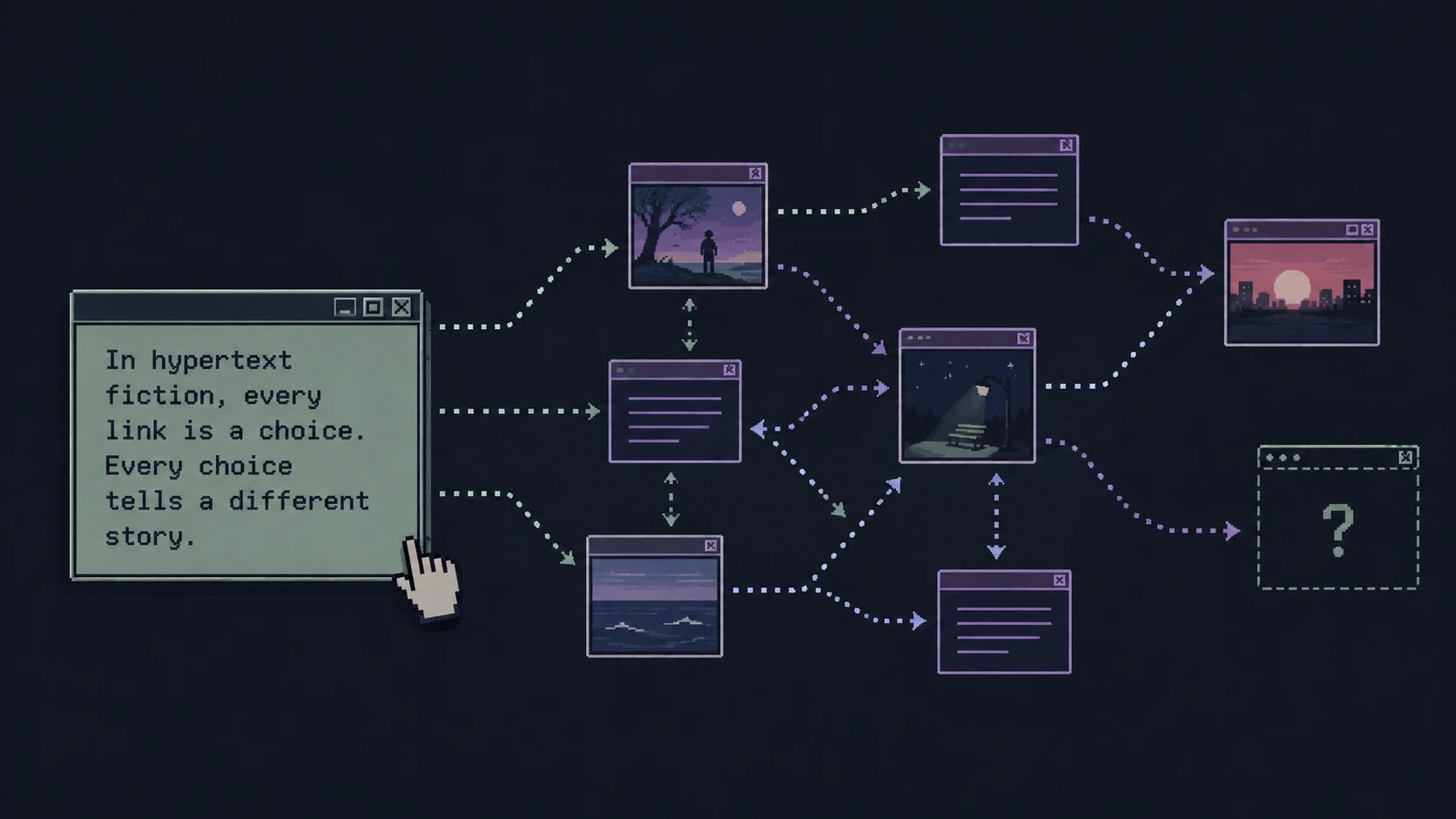
Hypertext fiction is a story built from linked chunks of text rather than a single fixed sequence of pages. Readers have a choice to click, and the path they take shapes what the story actually means. It exists because of computer technology and couldn’t be created in printed books. A reader can choose to click any link based on their choice.
Table of Contents
What Makes It Different From a Normal Story
We can see the novel as regular. You start at page one, and it ends with the last page. But Hypertext narrative works the opposite way. Like the text is split into small units, called lexias, and each of these links goes to others. There is no single correct route, and two readers can get different understandings of the same story.
This isn’t just a “choose your ending” trick. In serious hypertext fiction, the branching structure carries meaning on its own. Imagine a story about grief or memory that can loop back on itself or repeat fragments with small changes; this shows how people often remember things. Scholars generally classify hypertext fiction as electronic literature. It is often studied alongside generative poetry and other forms of computer-native writing.
Where Hypertext Fiction Actually Began
Somepeople though Hypertext came after the World Wide Web. That’s not true. The commonly cited starting point is Afternoon, a story written by Michael Joyce, the novelist who really needed to change the perspective of reading. After that, he collaborated with Jay David Bolter (Researcher) let to a hypertext authoring tool called Storyspace, First time its shown on public in 1987.
Afternoon reached readers in 1990 on a floppy diskette, published by Eastgate Systems. The story follows a man who believes he witnessed a car crash involving his ex-wife and son, and an interesting thing on which Lexia’s reader hits on: the end becomes different for everyone.
Later, Robert Coover called this function the Granddaddy of hypertext in the New York Times. In the same year, Apple introduced HyperCard for Mac users. It helped to create a stack of text and images without needing Storyspace at all. It’s a major reason early hypermedia experiments spread beyond a small circle of academics.
Notable Hypertext Fiction Works
Hypertext fiction became known through a handful of pioneering works that demonstrated what nonlinear storytelling could achieve. Many of these are still studied today in electronic literature.
- afternoon, a Story (1990) – Written by Michael Joyce and published by Eastgate Systems. He focused on the reader’s perspective through different hypertext fiction. Making each reading experience unique.
- Patchwork Girl (1995) – Created by Shelley Jackson using Storyspace, it remains one of the most influential hypertext narratives ever produced.
- Victory Garden (1991) – This hypertext novel shows the Gulf War through multiple perspectives.
- Twelve Blue (1996) – This is another masterpiece of web-based hypertext by Michael Joyce. It allows readers to weave together multiple interconnected storylines rather than follow a single narrative.
Nonlinear storytelling didn’t start with computers. In 1963, novelist Julio Cortázar offered readers 2 different chapter orders to choose from. What computers added wasn’t the idea of nonlinear storytelling, it was the mechanism. A printed book still forces one physical page order, while modern computers can track thousands of paths and hide links until clicked.
This shift transformed nonlinear writing from a simple storytelling experiment into a recognized field of study within Digital Humanities.
From Floppy Disks to Twine
The physical media was the only option in early hypertext fiction. Arrival of HTML changed the whole system; writers no longer needed specialized software or a publisher like Eastgate to reach readers, opening the door to digital publishing.
However, the genre experienced a major revival with Twine. Twine is a free tool that lets anyone write a branching story with plain text and is easy to export as an HTML file that runs in any browser. Games like Depression Quest used it to reach a more popular audience in the indie community that never heard the term hypertext fiction.
I noticed something: today, many browser-based narrative games, interactive documentaries, and visual novels still rely on ideas pioneered by hypertext fiction, even if they no longer use the term hypertext fiction.
| Year | Milestone |
| 1963 | Julio Cortázar’s Hopscotch experiments with nonlinear reading. |
| 1987 | Storyspace is introduced, giving writers a dedicated hypertext authoring tool. |
| 1987 | Apple’s HyperCard makes linked digital storytelling accessible to Mac users. |
| 1990 | afternoon, a story becomes one of the first commercially published hypertext novels. |
| 1991–1995 | Works like Victory Garden and Patchwork Girl expand the genre. |
| 2009 | Twine launches, making interactive storytelling accessible to anyone. |
| Today | Hypertext fiction continues through Twine stories, browser narratives, and experimental web projects. |
Hypertext Fiction vs Interactive Fiction
Although the two terms are often used interchangeably, they describe different traditions of digital storytelling.
| Readers click hyperlinks to navigate the story. | Players type commands or choose actions. |
| Focuses primarily on literature and narrative structure. | Often combines storytelling with puzzles and gameplay. |
| Early tools included Storyspace and HyperCard. | Famous examples include Zork and Inform-based adventures. |
| Modern examples are commonly built with Twine. | Modern interactive fiction also uses Twine, Ink, and parser engines. |
Why It Stayed a Niche Form
Hypertext fiction had real literary credibility in the early 1990s, even taught in university courses and reviewed in major papers. But it never went mainstream because nonlinear writing is a little harder to pull off. An author has to ensure the story makes sense no matter which lexia a reader arrives at, and early readers also needed specialized software. What survived is the core mechanic, letting reader choices shape the interactive story, which is now available in browser games and Twine’s itch.io community.
If you enjoy this kind of early web experimentation, it’s worth reading about the golden era of Flash websites and the indie web revival, both built on the same do-it-yourself (DIY) spirit.
For further reading, Wikipedia’s overview of hypertext fiction covers its formal literary history in depth, and the Electronic Literature Directory’s (individual work entries) catalog specific hypertext pieces worth exploring firsthand.
Where You Can Experience Hypertext Fiction Today
Although many classic works require old-generation software, hypertext fiction still exists. Modern creators continue to experiment with nonlinear storytelling through accessible web tools and digital publishing platforms.
Here are some places to explore
- Eastgate Systems, which still publishes classic hypertext literature.
- Electronic Literature Directory, an archive of digital literary works.
- Twine, the most popular modern tool for creating interactive stories.
- itch.io, where thousands of independent creators publish browser-based narrative experiences.
- The New River, a long-running journal dedicated to electronic literature and digital art.
The Bottom Line
Although it never became a mainstream literary movement, hypertext fiction permanently changed how stories could exist on computers: every branching browser story, clickable narrative, and Twine adventure owes something to the experiments that began decades ago with a handful of linked pages.

Asif BC is a web developer with 2 years of professional experience in website development and modern web technologies. As the creator of Curiouxify, he researches and writes about interactive websites, internet history, browser experiments, digital culture, and the evolution of the web. His articles combine technical knowledge with careful research to document the creative and lesser-known corners of the internet.