

A Now Page is a page on a personal website that is usually placed at the URL or Slug /now that answers a specific question, like what is this person focusing on right now? Where is this person located or travelling? Unlike the polished tone of a personal website, a Now Page reads like a quick update that your friend had not spoken to in a while. This is the exact reason why Now Pages have outlasted most short-lived web trends from the same era.
Table of Contents
Now Page vs About Page: What Is the Difference?
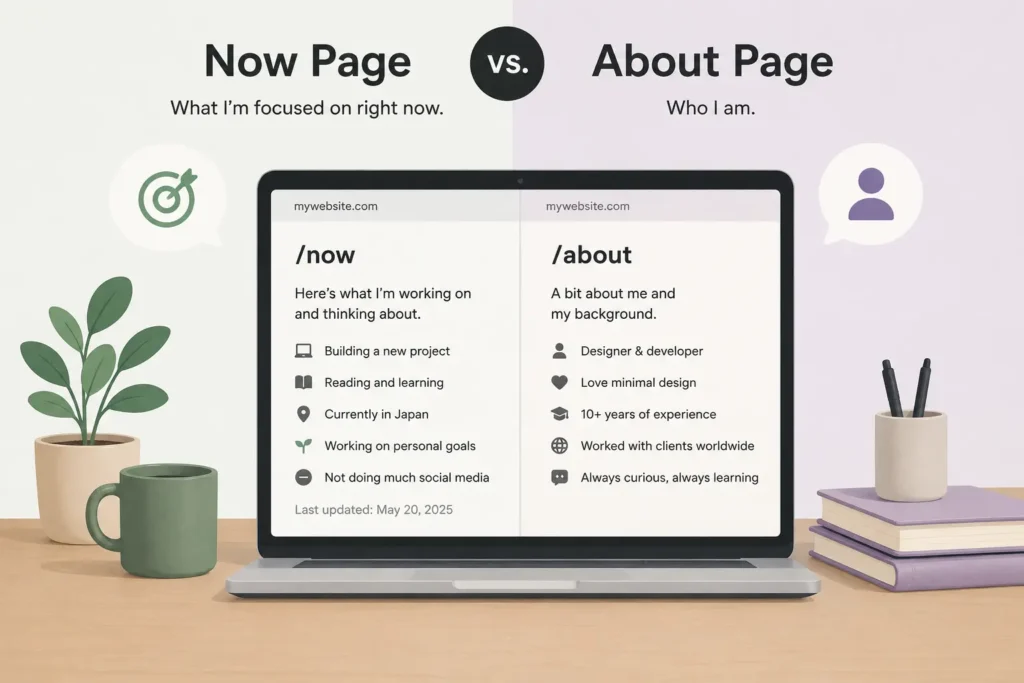
People often confuse the two, so it helps to compare them side by side.
| About Page | Now Page | |
|---|---|---|
| Answers | Who are you? | What are you doing right now? |
| Update frequency | Rarely, once every year or two | Every few weeks or months |
| Tone | Polished and biographical | Plain and conversational |
| Purpose | Introduce your background | Show your current focus and priorities |
| Common on | Portfolio websites and creator websites | Personal homepages and digital gardens |
When we talk about the About page, it usually stays fixed for months or years with background, skills, or a short bio. But in the case of the Now Page, it comes with the opposite job. Creators who keep updating the page status when something happens. One question here is: is this worth adding, or is it a distraction worth turning down? That format is one of the more practical reasons the habits held on for over a decade, well beyond simple novelty.
The Origin of the Now Pages Movement
The Now Pages movement traces to a specific date: October 21, 2015. That day changed the revolution of Now Pages. Derek Sivers, a musician and entrepreneur, wrote about adding a simple /now page to his own website because he was tired of replying to those who asked “what are you working on?” He framed it as a public declaration of priorities.
On this same day, Sivers published a post regarding this; then developer Gregory Brown added his own now page and announced it publicly. Within just hours, more people had done the same. Sivers watched it happen in real time and called it, correctly, the start of a movement. A month later, the count increased to almost 300, which is the exact reason why Sivers and Greg Albritton built a dedicated directory, nownownow, to track them all. I highly recommend visiting this site.
How Creators Structure a Now Page
One thing I notice is that there is no fixed template. But Now Page examples include a mix of the following. This is essentially how to create a Now Page that feels natural rather than forced.
- A short line on current work or main project
- What they are learning or reading at the moment
- A location note, useful for people who travel or relocate often
- Personal goals they are actively working toward
- A note on what they have stopped doing or deprioritized
- A last updated date, so visitors know how fresh the page is
Here is a cute example of Now Page: https://berniepng.com/now
That last point matters more than people expect. A Now Page without a visible update loses trust, since the entire premise depends on recency rather than polish. It sits in the same family as other simple, low-effort personal site features, like guestbooks, that ask almost nothing but still visitors remember.
Why the Indie Web and Digital Garden Communities Embraced Now Pages
The IndieWeb community adopted Now Pages early and documents dozens of examples on its own site; some of them are manually added and updated, while others pull data automatically from tools a person already uses. This will create an identity instead of letting a social platform represent you.
People who create digital gardens also use Now Pages; there is a reason for that. The digital garden site is always developing and growing, so Now Pages focus on what the creator is currently doing. This is why many personal websites and self-hosted websites include Now Pages, even without the use of any platform or plugins.
Does Anyone Still Need a Now Page?
Not everyone agrees the format is worth keeping. I know a blogger whose name is Joshtronic who argues that a Now Page is one more thing to maintain, and if you publish regularly, your posts already show what you are doing without a separate page. After some research, I also thought need to create a Now Page to understand what I am doing right now. A Now Page without any updates gets connected to a kind of abandoned page nobody visits anymore.
The honest answer comes when the Now Page is still worth it comes down to how often you already publish elsewhere. If your blogging site updates weekly, your posts may already do that job. If your website doesn’t update weekly or monthly, then a Now Page is useful for those who follow that blogger. It costs minimal when compared to running a successful blog.
Real Now Page Examples
A handful of Now Page examples are worth pointing to directly, since seeing the format in practice explains it faster than any description can.
What’s interesting is how different people maintain their Now Pages. Aaron Parecki has run an automatically updating Now Page since 2017, pulling data from tools he already uses rather than editing it by hand. After that, Caleb Hearth built something similar, updating automatically since 2023. On the manual side, Zinzy Waleson has kept hers current by hand since 2017; automation is not required for the format to last. Other websites like IndieWeb maintain theirs the old-fashioned way, editing a line or two whenever something changes.
Not every page is active; several pages on the IndieWeb wiki have not been touched in years, a useful reminder of the exact maintenance problem critics point to. Social media stories may reduce the need for Now Pages for some people, but they haven’t replaced them entirely.
Final Thoughts
A Now Page is a small idea that still holds up even after all these years. This is not a personal branding tool, not a portfolio, and not a replacement for blogging. It is what the developer or this person does without asking directly. If you already have a personal homepage or an active digital garden, adding a Now Page is one of the simplest ways to make a personal website feel more current and personal, as long as you are willing to keep it current.

Asif BC is a web developer with 2 years of professional experience in website development and modern web technologies. As the creator of Curiouxify, he researches and writes about interactive websites, internet history, browser experiments, digital culture, and the evolution of the web. His articles combine technical knowledge with careful research to document the creative and lesser-known corners of the internet.