
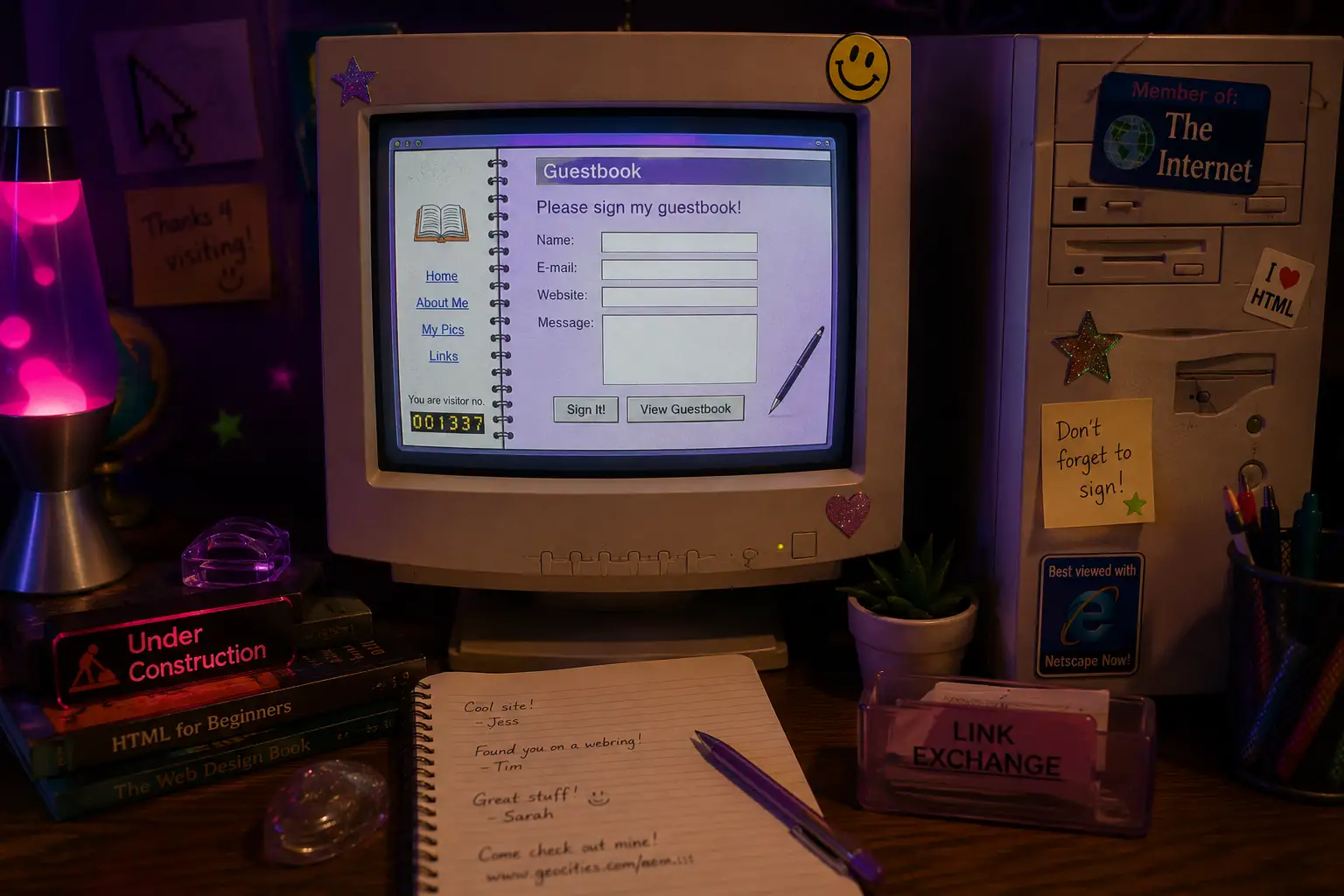
Somewhere between the hit counter and the webring badge, there used to be a small box at the bottom of everyone’s personal websites, and they asked them to do one thing: to prove that they had actually visited. That box was called an internet guestbook, and for most of a decade, it was one of the features that made a website feel like a place rather than just a page.
This is the story of how internet guestbooks became a default fixture of early guestbook culture in the website era, why so many strangers bothered signing them, and why nearly all of them eventually went down.
Table of Contents
What an Internet Guestbook Actually Was
There is no complicated method to this. An HTML guestbook form with 3 or 4 fields, such as name, email, website, and message. When you type something on it, hit the submit button, and a script appends your entry to a public page. There was no login and no account required. Most online guestbooks worked exactly this way, no matter which free host happened to be running them.
The technical foundation had existed since the early 1990s, when HTML forms first allowed a browser to send data back to a server administrator. What this whole format really did was borrow a much older social object, the visitor log you would sign at a hotel or a wedding, and rebuild it for a medium that had no idea about “what social” was even supposed to mean. This idea is what made early internet guestbooks feel personal in a way almost nothing else on the early web did.
Where the Idea Came From
The idea of this comes from centuries where people signed books at inns, churches, and exhibitions long before anyone dreamed up a network of linked documents. The version of the web kept the format almost untouched: a name, a date, a few lines, and they were displayed in the sort of creation date.
One thing I notice is that what changed is that anybody can see what other person submitted. A personal website guestbook could be read by anyone on Earth with the link, which in 1996 was still a genuinely odd thing to sit with.
The Guestbook Boom
In the early 1990s, a personal website without one felt unfinished. Website guestbooks had quietly become standard practice across the entire early web. When GeoCities launched, it quickly became the default home for millions of amateur web pages. For many people, their memories of the early web begin there. At that time, it hosted millions of personal pages, and the overwhelming majority of them had a guestbook link sitting right next to the hit counter and a row of 88×31 buttons.
Most of these owners did not write their own script for this. GeoCities, Tripod, and Angelfire could not run the server-side code a guestbook needed, so that gap was filled by free guestbook providers.
The Free Guestbook Provider Industry
Lpage was one of the earliest and most recongnizable guestbook in the 1990s, its little branding tag sitting at the bottom of the thousands of pages. Another one is Dreambook, a project tied to the same network behind early webring and “dreambook”. There are plenty of them, like GuestWorld, 123Guestbook, and Bravenet. Each of these offers the same basic deal: paste in a snippet of code, and your visitors get somewhere to leave a message.
It was not really a business, not in the way we would use that word now. It felt more like a public utility, ad-supported, free, and there were small banner ads in every entry form.
What Made Guestbook Culture Different From Comments Today
A modern comment box is frictionless, almost by design. You’re on anyone’s website, the box sits under the content, and a reply can disappear into a thread within minutes.
Signing one asked for more. You fill in the name, email, and a working link back to your own site, on a page with no algorithm deciding whether anyone would ever see what you wrote. That time, there was no reply button, no upvote option, no way to know if your message would matter to anyone besides the person who owned the page. It felt like saying, “I found your corner of the internet, and I wanted to leave a note.”, and I am leaving proof.
The Genre It Created
Another one is Dreambook, which simply says “sign my guestbook” in animated text, right above the form. Most of the entries look like this: “found you through…” and “my friend recommended”. Plenty closed with an invitation to sign back, or a note about how many visitors the counter had just ticked past.
The Slow Decline
Spam Found the Form First
By the early 2000s, automated bots had discovered guestbooks. What had once been a place for genuine messages quickly became a target for link spam. The automated bots had figured out a loophole on this, and the entire web was the easiest target, and they faced guestbook spam as a major problem. A page with a dozen good messages started filling up with link spam faster than any owner could clean by hand. When CAPTCHA was introduced, they slowed the problem but never really fixed it. Even some owners are forced to stop the web pages.
The Web Centralized
Spam damaged guestbooks, but it was not the reason they disappeared. It was where people’s attention went. Blogging platforms started shipping comment sections, now we call the blog comments, built directly into the page, tied to a specific post instead of an entire site.
Each of those replacements did one piece of the job better. Together, they did the opposite job worse. A guestbook held a permanent, chronological record tied to one address on the web. After the entry of a social media feed post, a comment thread makes no such promise. Most of them will not exist in five years, let alone fifteen.
What Replaced Guestbooks
Throughout my research, I found that comment sections inherited the first job: feedback, attached to content, visible to other readers. The arrival of social platforms absorbed the rest of it. The “I was here” instinct moved to likes and tags, the original conversation moved into personal messages, and the idea of a permanent public record mostly stopped being something anyone expected from a website at all.
An entry in someone’s guestbook belonged to the site it was written on. A comment on a platform belongs to the platform first, which is the exact story of internet guestbooks vs comment sections.
Why a Few Guestbooks Are Still Alive
The guestbook has not completely disappeared; it just became rare enough to feel deliberate again. Today, small communities rebuilding personal, hand-coded sites on places like Neocities have brought a fair number of these forms back, proof that old internet guestbooks still have a small audience around the world. The IndieWeb movement has done similar with newer infrastructure, using a protocol we call webmention, which just notifies another site that has been linked to or commented on your site.
What Guestbooks Tell Us About the Web We Lost
What actually disappeared was the friction, and the friction is the main thing on this. Leaving a message asked a visitor to slow down, write something real, and attach it to one specific place, knowing it will not be edited for years. Nothing about today’s web asks for that kind of commitment anymore. Some ideas will be lost, and some one will rise, that’s the law of technology.

Asif BC is a web developer with 2 years of professional experience in website development and modern web technologies. As the creator of Curiouxify, he researches and writes about interactive websites, internet history, browser experiments, digital culture, and the evolution of the web. His articles combine technical knowledge with careful research to document the creative and lesser-known corners of the internet.