
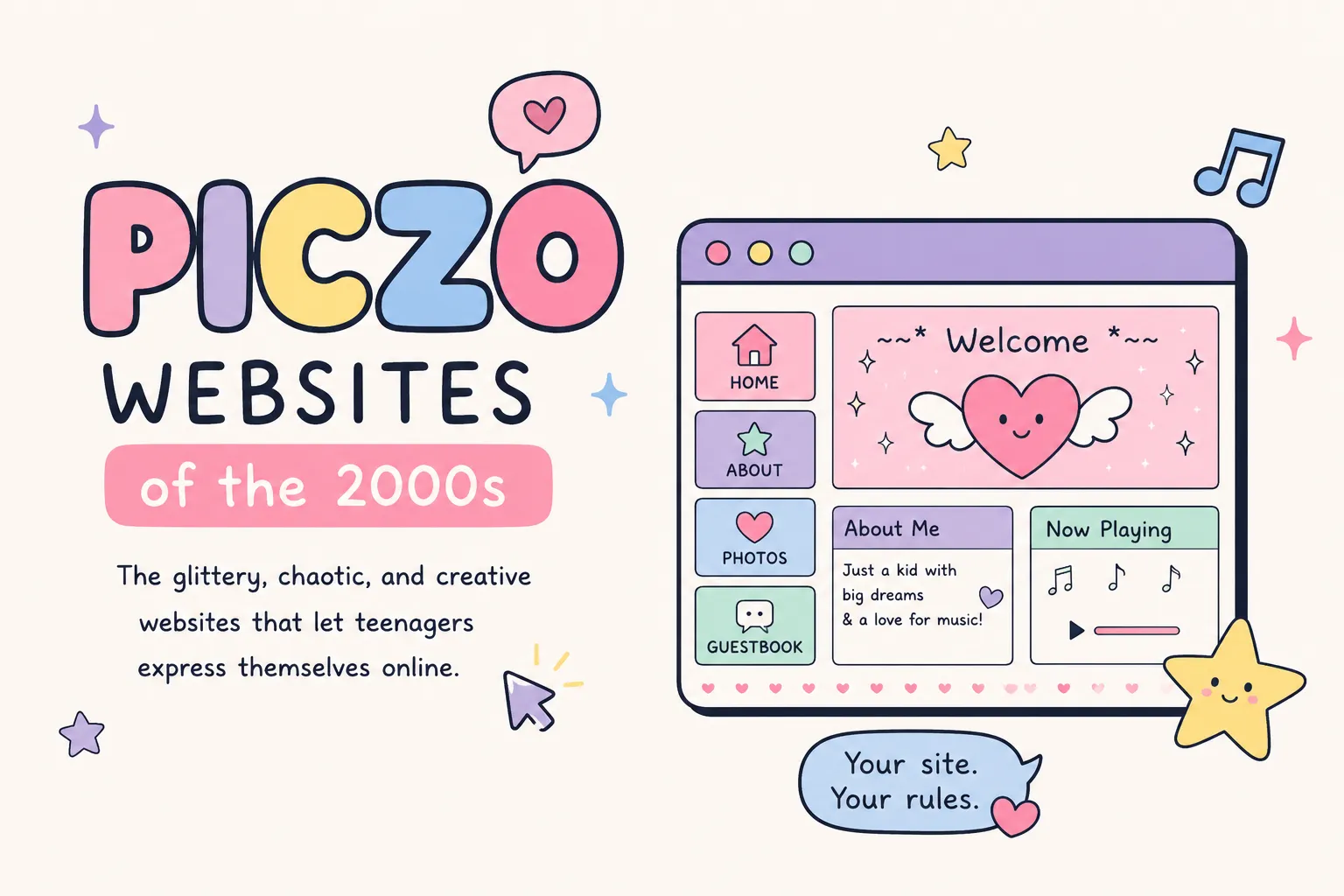
Piczo websites were free, drag-and-drop personal websites that let teenager in the early 2000s build their own web space without knowing a single line of code. Piczo mattered because it gave teenagers a place to build their own websites before Facebook dominated the online world. If you search for what happened to Piczo websites, the short answer is that Piczo grew into one of the largest teen sites in the world, was acquired twice, and, unfortunately, shut down in November 2012. Piczo websites are one of the clearest examples of social media before Facebook.
Table of Contents
What Was Piczo?
First of all, Piczo started life under a different name. In 2002, Jim Conning founded a photo-sharing service called Funtigo for adults who wanted to tell a story through their pictures. But unfortunately, it struggled. When Conning noticed that teenagers, rather than adults, were using it in interesting ways, he rebuilt the concept and relaunched it as Piczo in 2005.
The new version was completely focused on teens. Instead of a rigid photo gallery, users got a blank canvas: multiple pages, customizable layouts, and total control over colors, fonts, and even background sound. It quickly spread on younger audience, especially in the USA and Canada. Some reports suggest around 10 million users were active in 2006 and 2007.
How Piczo Websites Worked in the 2000s
Understanding how Piczo websites worked in the 2000s explains why the platform felt so different from a typical old social networking site.
Drag and Drop Page Building
Users can easily build the site with simple visual tools, but Piczo also lets more advanced users to write in code also. That flexibility is a big reason Piczo pages looked so different from one another compared to the templates of many 2000s social media platforms.
Guestbooks and Message Boxes
Every Piczo page had a guestbook or message box bolted onto it; it looked like a comment box. Visitors left notes, inside jokes, and the occasional drama, which is exactly the kind of interaction you can see on an internet guestbook.
Music, GIFs, and Glitter
Autoplaying music, sparkly cursor effects, and rotating GIFs were practically a signature of the platform. Later, this chaotic style became a part of retro web design, and people still remember this type of website when it comes to early 2000s website design.
Custom URLs and Layouts
Every user had a subdomain like a username dot piczo dot com, which made the site feel like a genuine home base rather than just a profile page.
The Piczo Aesthetic: Glitter, Chaos, and Teenage Self-Expression
What made Piczo websites different from other sites was their garish colors of combinations, alternating capital letters, and cluttered layouts. Teenagers could confidently say, “This is my site.” The same instinct shows up across other corners of early web culture, like blinkie websites or customized profile decorations we can find in 88×31 web buttons.
This aesthetic wasn’t accidental. Before algorithm-driven feeds existed, a personal website design was the only way to express personality online, and Piczo gave teens more creative freedom than other teen websites.
What Happened to Piczo Websites?
The disappearance didn’t happen overnight. Piczo’s business changed hands twice before it disappeared for good. Here is the timeline:
- 2005: Piczo launches as a dedicated teen website builder.
- 2006 to 2007: Piczo becomes the largest teen site in the UK; interestingly, it all happened by word of mouth.
- 2009: Piczo is acquired by Stardoll ( A swedish paper doll company).
- 2012 (September): Posh Media Group buys Piczo.
- 2012 (November): Piczo.com officially shuts down.
At that time, Facebook and later Instagram offered easier and more user-friendly ways to connect with others. When I read in Wikipedia notes, there was a new Piczo website briefly resurfaced years later, but it didn’t work like the first approach.
Piczo vs Other 2000s Social Networking Sites
Piczo is often grouped with MySpace alternatives, but the comparison only goes so far.
| Site | Focus | Customization |
| Piczo | Personal websites for teens | High |
| MySpace | Social profiles with music | Moderate |
| Bebo | Social networking | Low–moderate |
| Freewebs (Webs) | Personal website building | High |
In the case of MySpace, it leaned on a single format, but Piczo let users build entire multi-page sites.
Can You Still Find Old Piczo Websites?
The official site of Piczo itself is gone, and most old Piczo websites from the 2000s vanished along with it because the platform didn’t offer a real export or backup system. Some of them can still be found through the Wayback Machine.
Screenshots shared in old forum threads and fan communities remain the only proof of what specific pages looked like.
Piczo’s Legacy in Retro Web Design
Piczo rarely gets the credit that MySpace does, but its influence on old web design is easy to trace. The idea of a fully customizable web page as a form of identity lived on in later platforms. Anyone interested in this topic might also enjoy exploring dollmaker websites and fan shrine websites, both of which share Piczo’s DIY, decorative approach to building online spaces.
Frequently Asked Questions
Is Piczo still around in any form?
The original Piczo website shut down in November 2012. After years, the site briefly reappeared under the same name. But it has no connection to the original teen community or its archived pages.
Why did Piczo disappear instead of adapting like other sites?
Piczo’s format was built around desktop HTML editing at that time. Years later, web was shifted to fast toward mobile apps and simplified social feeds, which made Piczo hard to position in the market.
Piczo was never just a website builder. It was the first place an entire generation learned that a web page can give self-expression, built entirely on their own terms. The idea didn’t completely disappear. just moved somewhere else, and it’s still visible in every corner of the internet where people choose to build something interesting rather than picking a template.

Asif BC is a web developer with 2 years of professional experience in website development and modern web technologies. As the creator of Curiouxify, he researches and writes about interactive websites, internet history, browser experiments, digital culture, and the evolution of the web. His articles combine technical knowledge with careful research to document the creative and lesser-known corners of the internet.