
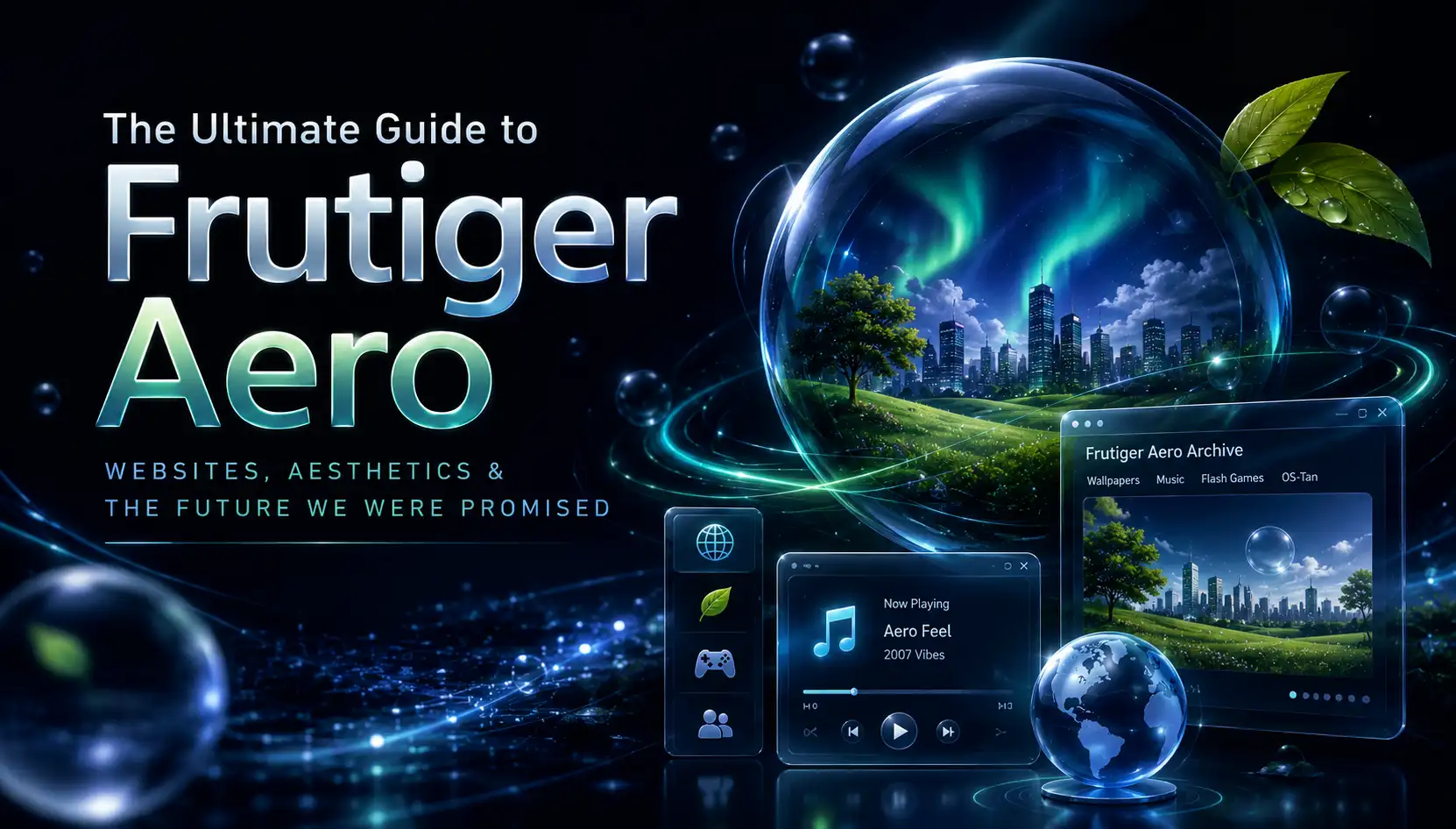
If you’ve been falling down the Frutiger Aero rabbit hole, you already know what’s going on next. The specific ache for a version of the future that felt warmer, cleaner, and more hopeful than we got. The important thing I noticed is that you’re not just nostalgic for a design style, you’re nostalgic for what technology promised.
This guide explores real Frutiger Aero websites you can visit today, from archives and community hubs to modern experiments, plus something most Frutiger Aero content skips entirely.
Table of Contents
What Actually Makes a Website “Frutiger Aero”? The 5-Layer Test
When I researched this, I noticed that most of the articles describe Fruitiger Aero as glossy buttons and nature imagery. When we look through indirectly its almost the same, but it misses the hierarchy. Not all five layers are equal, and the sites that feel genuinely Aero hit more of them.
Layer 1: Surface (Most Visible)
Translucent UI elements and Glossy. Buttons that look slightly wet. Navigation bars look like frosted glass depth. The immediate visual signature of Windows Vista’s Aero interface across an entire web era.
Layer 2: Color
Leaf green, sky blue, aqua, and soft white, but never as flat blocks. The sense of depth comes from gradient layering and transparency, not paint-bucket fills. If you can describe the background color with a single hex value, then it’s not Frutiger Aero.
Layer 3: Nature as Interface
This is where the aesthetic gets philosophically interesting. The aurora borealis, bokeh, bubbles, dewy grass, and tropical fish you see on the screen aren’t decoration. Every nature motif is the designer saying, “Don’t be afraid of this.”
Layer 4: Skeuomorphic Logic
Sounds interesting, right? The underlying philosophy: digital objects should feel like physical ones. Sliders with real knobs. The whole interface pretends it has texture and weight.
Layer 5: Emotional Register (Hardest to Fake)
This is what separates a real Frutiger Aero website from nostalgic pastiche. The real one is genuinely optimistic, not ironic, not retro-as-commentary, just earnestly excited about being alive in a digital future. Recreating this visual language is the main issue of many “Frutiger Aero-inspired” things, which feel slightly hollow.
The Essential Frutiger Aero Websites
1. Frutiger Aero Archive
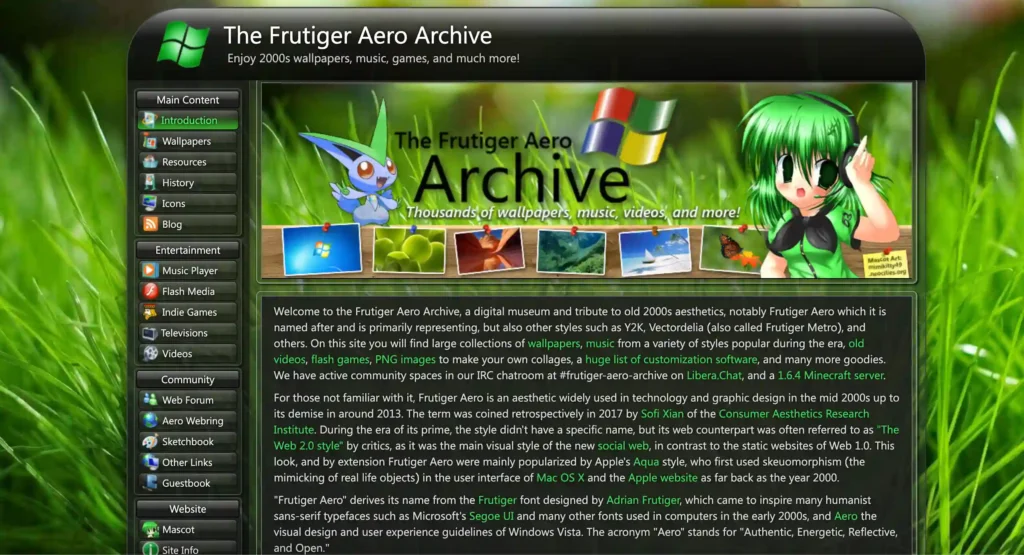
Visit: https://frutigeraeroarchive.org/
What makes this archive is that it is aesthetic rather than descriptive. The site was launched in August 2024 with vanilla HTML, CSS, and JavaScript. It feels like we entered the 2008 era of websites.
The content is genuinely impressive, featuring a massive wallpaper collection, era-authentic music, playable Flash games, OS-Tan artwork, and Vocaloid-era anime wallpapers, a flash games section with actual playable Flash games, OS-Tan artwork, and Vocaloid-era anime wallpapers. There is also a Minecraft server, which says a lot about the community behind the project and why it exists.
By January 2025, it had crossed 133,000 views. For a completely handmade indie site, that’s not a niche curiosity. That’s real community.
2. Consumer Aesthetics Research Institute (CARI)
CARI is where the term “Frutiger Aero” was named in 2017 by Sofi Xian, and that fact is worth sitting with. An important point is that someone had to name this aesthetic before a community could form around it before the community could coalesce around it. The original name mattered.
The CARI page is lean by design: it defines the aesthetic, credits its origins, and links to an Are.na board of curated visuals. What makes me think that an exclusive interview with the CEO of Asadal, a Korean based stock photography site whose images are among the most iconic Frutiger Aero visuals in existence.
If you’ve ever seen a glowing orb over a misty mountain or a translucent blue sphere against a sunset, you’ve probably seen Asadal’s work without realizing it. even without knowing it.
3. Aesthetics Wiki
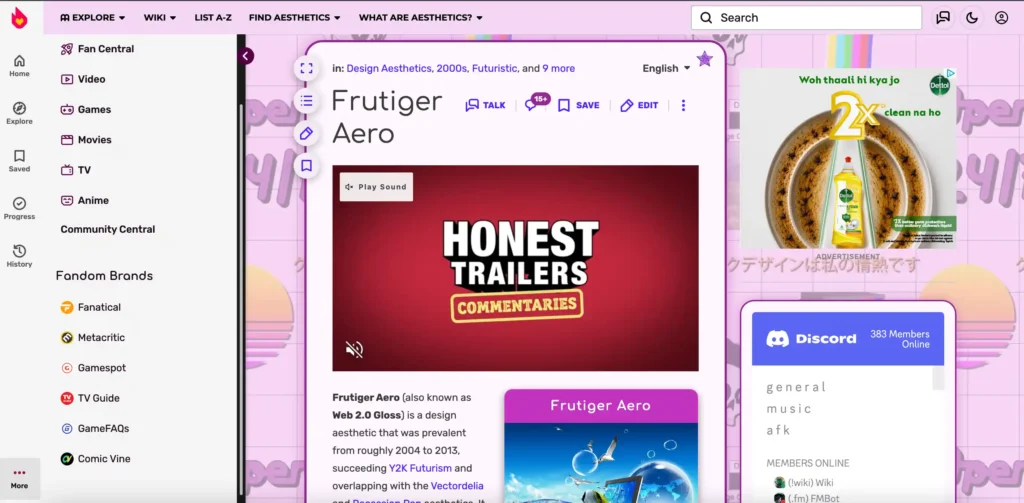
Visit: https://aesthetics.fandom.com/wiki/Frutiger_Aero
This was the most comprehensive single reference document on Frutiger Aero. When I read this, I got the point, no other sources matches its breadth on subgenres: Frutiger Eco, Dark Aero, DORFic, Technozen, Frutiger Aurora, Neo-Aero, and more.
The subgenre taxonomy is where this page becomes genuinely useful. “Dark Aero” in particular is worth understanding. It inverts the color palette (deep blues, blacks, bioluminescent accents) while keeping the glass and translucency language. It’s Frutiger Aero at 3 AM rather than Frutiger Aero at noon.
4. Frutiger Aero on Neocities
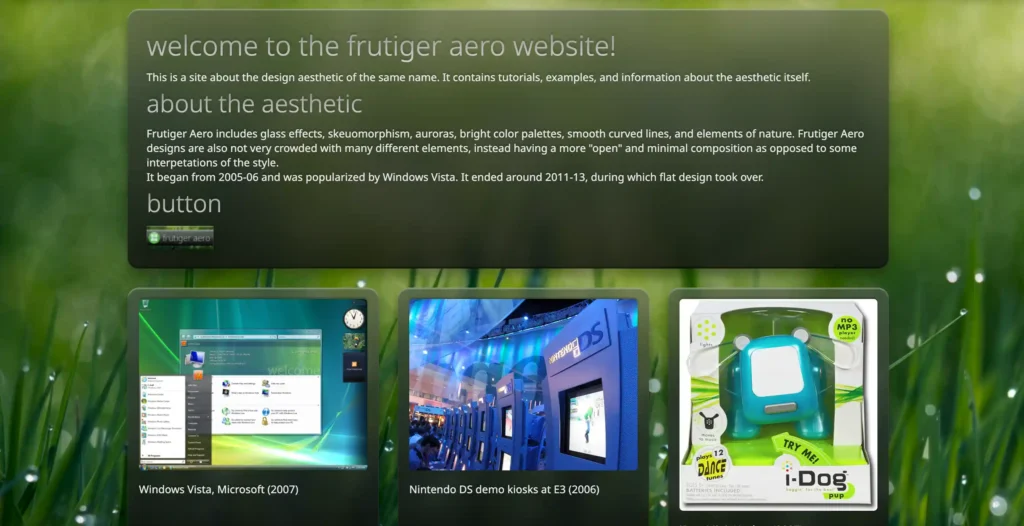
Visit: https://frutiger-aero.neocities.org/
It’s simpler and smaller than the Archive, but it has something the others don’t: a complete tutorials section for building your own Frutiger Aero website. This type of content is genuinely rare because most sites document the aesthetic rather than teaching people to reproduce it.
If I come as a learner, this site section is also well-curated for newcomers also. The Nintendo DS kiosks at E3 2006 and the Hasbro iDog appear here as real-world touchstones, which is a more honest framing of the aesthetic than purely digital examples. For the people who want to build in this style, this site is best for that.
5. Frutiger Aero Community
Run by the Consumer Aesthetics Network, this site has a mascot called Aqua the Android, which tells you the vibe immediately. The focus is social rather than archival: a chatroom, fan art gallery, and resources for newcomers.
When we come to the design side, the design is authentically executed with rounded navigation icons, toggleable ambient background music, and adjustable text sizes. The color palette immediately evokes the visual style of 2007.
What These Sites Reveal That Individual Analysis Misses
Looking across all these sites, three patterns emerge that don’t appear on any single page.
1. The handmade web as a political statement.
Every significant Frutiger Aero site is hand-coded in vanilla HTML, CSS, and JS with no frameworks. This is not a technical accident. It’s a deliberate rejection of the template-optimized, conversation-rate-engineered modern web.
2. The IRC/Minecraft/forum ecosystem.
Interestingly, the most active Frutiger Aero communities aren’t on Discord. They’re in IRC, Neocities, and forums. This is consistent with the aesthetic’s broader philosophy: older, slower, more deliberate digital spaces over algorithmically accelerated social media. The community structure matches the aesthetic.
3. Nature imagery as grief, not nostalgia.
In 2007, those auroras and bubbles and dewy fields were aspirational, technology becoming nature, the digital and organic merging. Last year, I read about a para regarding this, “the future we were promised but never delivered.” The aesthetic now carries mourning for a version of the digital future that the industry abandoned in favor of flat design, dark patterns, and engagement optimization.
Apple’s Liquid Glass: The Mainstreaming of Frutiger Aero
In 2025, Apple released its Liquid Glass design language. The visual grammar, soft gradients, depth and layering, is recognizably Frutiger Aero’s vocabulary, arriving via a $3 trillion company’s flagship OS update.
The long-term impact remains uncertain. Frutiger Aero went from an obscure aesthetic named by a research institute in 2017 to influencing mainstream design at the highest level within a decade. Communities within the Indie Web movement, hand-coding Neocities pages and IRC chatrooms, preserved something that turned out to be genuinely worth preserving.
The #frutigeraero hashtag crossed 30 million uses on TikTok and above 50k members in Reddit’s r/FrutigerAero.
Quick Reference
| Site | Best For | Layers Hit |
| frutigeraeroarchive.org | Wallpapers, music, games, archives | All 5 |
| cari.institute | Research, origins, primary sources | Context and history |
| aesthetics.fandom.com | Deep research, subgenres | Breadth |
| frutiger-aero.neocities.org | Beginners, tutorials | Introduction |
| frutigeraero.org | Community, fan art, people | Social |
| frutiger-aero.org | Modern examples, pop culture | Demonstration |
The internet built something genuinely good during the Frutiger Aero era, an implicit agreement that technology should feel warm, alive, and connected to the natural world.

Asif BC is a web developer with 2 years of professional experience in website development and modern web technologies. As the creator of Curiouxify, he researches and writes about interactive websites, internet history, browser experiments, digital culture, and the evolution of the web. His articles combine technical knowledge with careful research to document the creative and lesser-known corners of the internet.