Last Updated: December 30, 2025
Nowadays everyone is searching for future robots that will become smarter than humans. The direct answer is yes, it’s possible, and it could reshape our lives in ways we’ve only seen in movies. Robots have the upper hand in logic, prediction, memory, and decision-making. But the question of whether they replace us or support us depends entirely on how we program, control, and guide their intelligence. Many movies have already explored this topic many times in films like I, Robot, Eagle Eye, and Ex Machina.
As reported by Forbes tech futurist Bernard Marr, in 2035, there will be 13 million active humanoid robots.
What “Smarter Than Humans” Really Means
Being smarter doesn’t mean robots suddenly become emotional like humans. In my opinion there are:
- analyzing data,
- solving massive problems,
- learning at incredible speed,
- and predicting outcomes with accuracy humans can’t match.
One of my favorite movies, Eagle Eye, already shows this, where an AI system predicts human behavior in real time. Another one is in Ex Machina, where a robot manipulates emotions with cold precision.
Now a world where humans will still excel in empathy, creativity, and moral judgment. But in the case of robots, they may dominate the logic area.
How Robots Could Become Smarter Than Us
Future robots will be a combination of AI, sensors, memory, and self-learning systems that grow continuously.
Unlike humans, there are so many differences between humans and robots, like they don’t forget, they don’t get tired, and they don’t get emotional when making decisions.
Future robots will combine AI, sensors, memory, and self-learning systems that grow continuously.
Unlike humans, they don’t forget, they don’t get tired, and they don’t get emotional when making decisions.
How Robots Overtake Human Intelligence
- Learning on their own through constant self-training
- Predicting outcomes by scanning massive data instantly
- Acting without emotional confusion or stress
- Improving faster than humans through updates and new algorithms
Will Robots Replace Humans? The Real Answer
People fear the question, “Will robots replace humans?”
But in my opinion, the truth is balanced.
Robots won’t replace humans; they will replace tasks that don’t require emotional and creative thinking. In the movie Big Hero 6, Baymax didn’t replace the doctors; instead, he supported them. That’s the future.
Jobs Robots Will Likely Replace
- Dangerous jobs like mining, exploration, and bomb disposal
- Repetitive factory and warehouse tasks
- Ultra-precise jobs like microsurgery assistance
- Data-heavy roles like fraud detection and surveillance
Robotics and Humanity: A Future Partnership
After I read some articles, I found that the future is not humans vs robots. It’s robotics and humanity living side by side. Robots will help humans in ways we’ve seen in films:
- Her shows emotional AI companions
- Chappie explores human-like robot learning.
- I, Robot debates trust between humans and machines.
Real-life future robots could serve as helpers, companions, teachers, and protectors.
Examples like Emma the robot and Kai the artificial intelligence robot already show early versions of emotional AI.
Where Robots Will Support Humans Daily
- Caring for elderly people with health monitoring
- Serving as emotional companions to reduce loneliness
- Teaching students with personalized learning
- Supporting doctors with 24/7 medical tracking
- Emotional support for those who feel lonely.
This partnership could make society more efficient and more connected.
The Future Robot Society: Homes, Schools, and Cities
In the future robots will be everywhere. According to the UAE Minister of Affairs, over 20 billion robots will serve humans in 2050. It will help to guide students, clean homes, deliver goods, and even participate in sports.
Sports could also evolve into the robotic future of sports, where robots compete with precision, power, and zero fatigue.
How Society Will Change With Smarter Robots
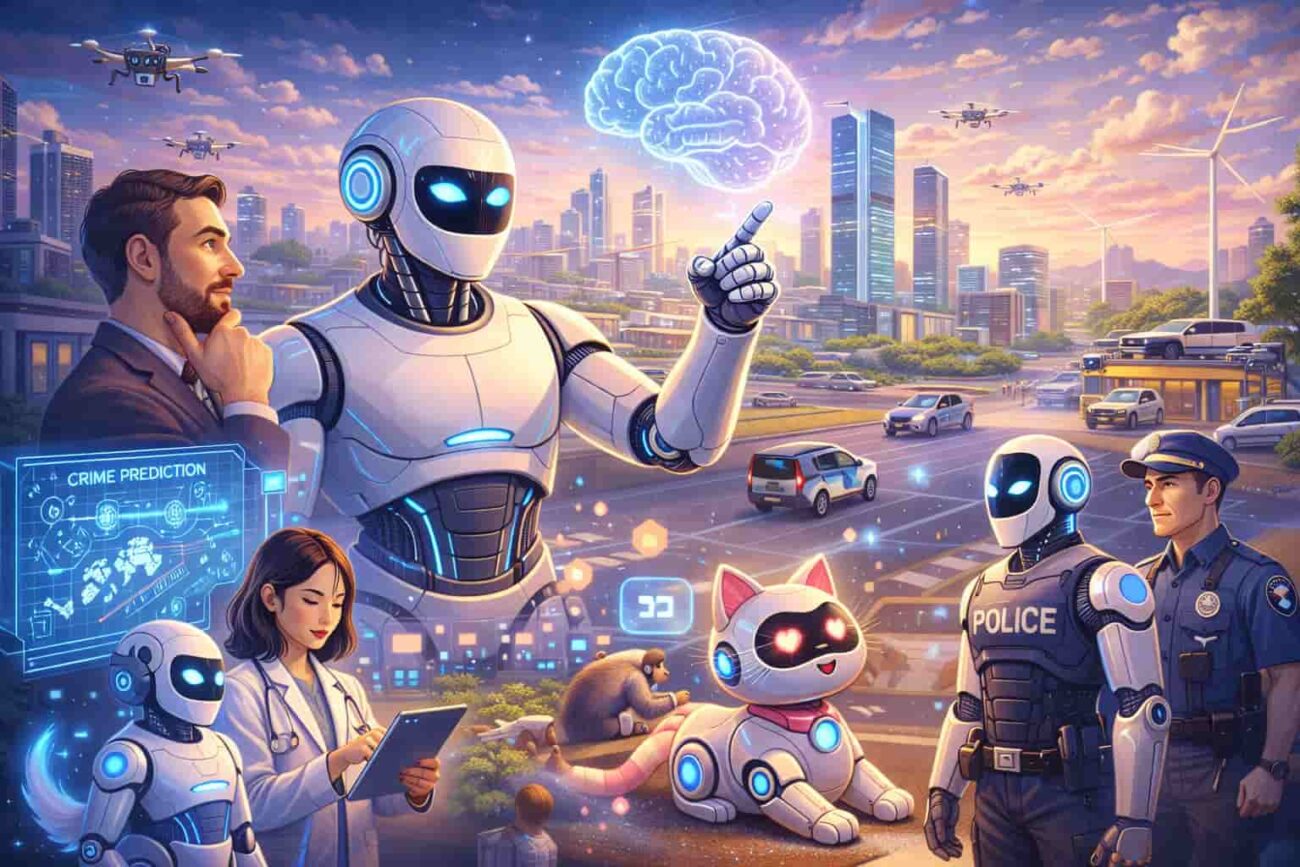
- Faster emergency response with robot police and drones
- Sports and entertainment becoming more advanced and accurate
- AI predicting crimes before they happen
- Transportation turning fully autonomous and safer
Will Robots Become Superintelligent by 2050?
In my opinion, by 2050, we may see robots and AI outperforming humans in nearly every technical area. But movies like Eagle Eye and The Matrix warn about the consequence of robots with freedom.
The main solution for this? Strong global AI laws, human oversight, and ethical programming.
What Happens If Robots Become Superintelligent?
- Robots solve massive global problems like climate modeling.
- Errors in medicine and transport drop to near zero
- Society becomes more dependent on AI for decisions.
- Governments enforce strict robot ethics and safety rules.
Final Thought
Future robots becoming smarter than humans is not the end of humanity. It’s the beginning of a new age. If we handle the robots with responsibility and ethics, I trust they can become our greatest allies.
The future is not humans losing.
It’s humans rising higher with robotic support, innovation, and smart control.
FAQ
1. What is the future of robots?
The future of robots will be filled with emotional robots, AI companions, home assistants, and humanoid machines that work with human command or AI command.
2. What will robotics be like in 2050?
By 2050, robotics will be highly advanced, with superintelligent machines capable of learning new things, reasoning, and understanding human emotions.
3. Who is India’s first AI robot?
India’s first AI robot is Rashmi, created by Ranjit Shrivastava. That robot can speak multiple languages, recognize emotions, and interact with people.
